Why Your Business Needs a 24/7 Customer Support System

Today’s business world is a competitive race, and having a 24/7 customer support system is the engine that helps you stay ahead. Customers expect instantaneous feedback more than ever before. In fact, recent industry data reveals that 90% of customers rate an “immediate” response as critical to their satisfaction.
Providing reliable, round-the-clock support can be the deciding factor between closing a deal and losing a customer to a competitor. With a robust 24/7 support strategy, your business is ready to capture every opportunity, day or night.
The Competitive Advantage of 24/7 Customer Support
In a fast-paced global economy, availability is no longer a luxury—it’s a necessity. A 24/7 customer support system gives you a distinct edge by allowing you to serve customers whenever they are active, not just when your office is open.
- Global Reach: Diverse time zones mean your “9-to-5” is someone else’s purchasing prime time.
- Trust Building: Being available at 3 AM builds immense trust and signals that you value your customer’s time.
With the rise of digital platforms, customers demand immediate feedback. Research shows that companies lose billions annually due to poor customer service. Offering 24/7 availability creates a safety net that captures this revenue by ensuring no query goes unanswered.
How a 24/7 Customer Support System Sets You Apart
Nowadays, patience is thin. Customers faced with a problem expect a solution now. A business that offers a reliable, round-the-clock support team immediately differentiates itself from peers who ask customers to “wait until Monday.”
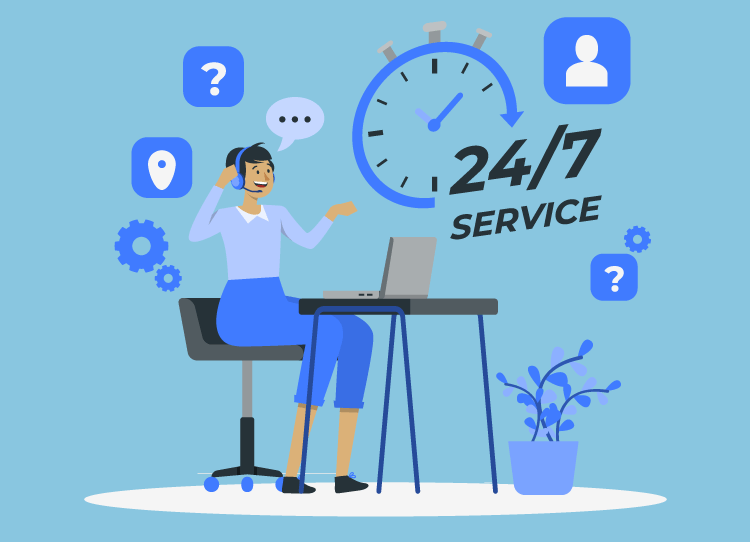
Through 24/7 customer support, you provide personalized, timely assistance that keeps satisfaction levels high. This availability:
- Provides Valuable Feedback: A continuous loop of customer interactions helps identify product improvements faster.
- Increases Customer Loyalty: Customers stick with brands that are there when things go wrong.
- Promotes Brand Reputation: Positive reviews often stem from crisis moments resolved quickly outside standard hours.
Meeting Modern Customer Expectations
The “10-Minute” Standard
As the world becomes increasingly digital, expectations have evolved. Today’s customers are tech-savvy and demanding.
- 60% of customers define “immediate” as 10 minutes or less.
- Live chat satisfaction sits at 87%, significantly higher than phone support (44%), proving that customers want quick, text-based answers.
Meeting these expectations isn’t just about answering tickets; it’s about proactive engagement. Customers seek quick, effective responses and a genuine commitment to satisfaction
The Power of Instant Feedback
To exceed expectations, you must eliminate “dead air.” When a customer submits a query, an instant acknowledgment (even from an automated system) reassures them that their voice has been heard. This immediacy leads to positive reviews and improved retention.
Support Genix Tip: You don't need a massive night shift team to offer instant feedback. The Support Genix WordPress Support Ticket Plugin can automate responses and manage tickets 24/7, ensuring no customer feels ignored.Support Genix
WordPress Support Ticket Plugin
Take Your Customer Support to The Next Level and Boost Customer Satisfaction Rates
24/7 Customer Support and Sales
Correlation Between Support and Revenue
The link between 24/7 customer support and sales is undeniable. In a saturated market, support is the product differentiator.
- 78% of customers have backed out of a purchase due to a poor customer experience.
- Prompt responses reinforce loyalty, turning one-time buyers into repeat customers.
How Availability Boosts Conversion
Nothing beats availability. When a potential lead has a pre-sales question at 11 PM, a 24/7 system (like a chatbot or knowledge base) can provide the answer that secures the sale.
- Capture Global Markets: Tap into revenue streams from Europe, Asia, or the Americas without hiring local teams.
- Real-Time Conversion: Answering a question instantly increases the chances of converting a visitor into a paying client.
Recommended Blog for You:
👉 What is Customer Segmentation: Everything You Need to Know
👉 The Key Elements of Good Customer Service
👉 8 Best WordPress Ticket System Plugins: A Comprehensive Overview
👉 7 Best Zendesk Alternatives You Should Consider: Find the Best Help Desk Solution
Choosing the Right 24/7 Customer Support System
With countless options available, choosing the right system is critical. You need a platform that unifies your channels—phone, email, chat, and social media—into one seamless workflow.
Key Features to Look For:
Here is a checklist to ensure you select a system that powers true 24/7 support:
- Omnichannel Support: Manage email, chat, and social tickets in one place.
- Automation & AI: Look for features that route tickets and send auto-replies to provide “instant” support even when agents are asleep.
- Self-Service Options: A robust Knowledge Base or FAQ section allows customers to solve their own problems, reducing ticket volume by up to 80%.
- Reporting & Analytics: Track response times (FRT) and resolution rates to identify bottlenecks.
- Scalability: Ensure the system grows with you as your ticket volume increases.
- Integration: It must play nicely with your CRM (like WooCommerce or Slack) to ensure smooth data transfer.
The Solution: Support Genix offers these exact capabilities. With an AI-powered reply assistant, intelligent chatbots, and unlimited tickets, it transforms your WordPress site into a 24/7 support powerhouse without the enterprise price tag.
Tips on What to Look for in a Support System
Here are some tips on what to look for in a support system-
- Identify your specific support needs: Consider the types of support channels (e.g., phone, email, live chat) you require and the volume of support interactions you anticipate.
- Accessibility and availability: Look for a support system that offers 24/7 availability or at least aligns with your desired support hours to ensure prompt assistance for your customers.
- Ticket management: Ensure the support system provides efficient ticket management features, such as ticket routing, prioritization, and tracking, to streamline your support workflow.
- Knowledge base and self-service options: Seek a system that allows you to create and maintain a knowledge base with self-help articles, FAQs, and tutorials. This empowers customers to find answers independently, reducing support requests.
- Integration capabilities: Consider whether the customer service support system can seamlessly integrate with your existing tools like CRM or helpdesk software to ensure smooth data transfer and enhance productivity.
- Multichannel support: Choose a service support system that supports various channels, such as phone, email, live chat, and social media, to cater to diverse customer preferences and improve accessibility.
- Reporting and analytics: A service support system should have strong reporting and analysis capabilities. This enables you to track key metrics, measure performance, and gain insights to improve your support operations.
- Personalization and customization: Seek a support system that allows customization of the customer experience, such as branded ticketing portals or personalized responses. This enhances your brand image and improves customer satisfaction.
- SLA (Service Level Agreement) management: Consider whether the support system allows you to set and manage SLAs to ensure timely resolution and meet customer expectations.
- Collaboration and internal communication: Evaluate the support system’s features for internal collaboration, such as agent notes, internal chats, or shared inboxes, fostering effective teamwork and information sharing among support agents.
- Customer feedback and surveys: Look for a support system that provides built-in feedback mechanisms, like customer surveys or ratings, to gather insights and continuously improve your support quality.
- Scalability and flexibility: Consider whether the support system can scale with your business growth and modify it to meet shifting demands. This ensures that your support system remains effective as your customer base expands.
- Security and data protection: Ensure that the support system prioritizes the security of customer data with measures like encryption, access controls, and compliance with industry standards.
- Reputation and customer reviews: Research the reputation and customer reviews of the support system you are considering to gain insights into user experiences, reliability, and overall satisfaction.
- Training and support resources: Evaluate the availability of training materials, documentation, and support resources provided by the support system vendor to assist your team in effectively using the system.
Remember to prioritize the features that align with your business requirements and select a support system that best fits your specific needs and budget.
Importance of Choosing a System That Fits Your Needs
When choosing a system to support your business operations, it’s essential to consider your unique needs. One size does not fit all, and investing in a system that doesn’t fit your business model can lead to productivity loss and frustration. Instead, prioritize finding a product that offers enhanced support and caters to your specific requirements.
- Alignment with business goals: Choosing a system that fits your business needs ensures that it aligns with your overall objectives and supports your strategic goals.
- Efficient operations: A system tailored to your business needs enhances operational efficiency by streamlining processes, automating tasks, and reducing manual effort.
- Improved productivity: When a system is well-suited to your business needs, This makes it possible for your employees to work more productively and effectively.
- Enhanced customer experience: A system that caters to your specific requirements allows you to provide a better customer experience. This can include faster response times, personalized interactions, and seamless support across multiple channels.
- Cost optimization: By choosing a system that fits your business needs, you can avoid unnecessary expenses on features or capabilities that you don’t require. This helps optimize costs and allocate resources more efficiently.
- Scalability and flexibility: A system designed to fit your business needs can scale and adapt as your business grows or changes. It provides the flexibility to add or modify features to accommodate evolving requirements.
- Data-driven decision-making: A system that aligns with your business needs provides accurate and relevant data, empowering you to make informed decisions based on real-time insights and analytics.
- Seamless integration: When a system fits your business needs, it can seamlessly integrate with other tools and systems you use, enhancing data flow, efficiency, and collaboration.
- Reduced learning curve: Choosing a system that aligns with your business needs minimizes the learning curve for your team. Familiarity with the system improves adoption rates and reduces training time and costs.
- Competitive advantage: Selecting a system that fits your business needs gives you a competitive edge by enabling you to leverage technology effectively, optimize processes, and deliver superior customer experiences.
- Long-term sustainability: Investing in a system that fits your business needs ensures its long-term viability and usability, reducing the need for frequent system changes or replacements.
Overall, choosing a system that fits your business needs is crucial for maximizing efficiency, improving customer satisfaction, optimizing costs, and driving overall success in the long run.
Support Genix
WordPress Support Ticket Plugin
Take Your Customer Support to The Next Level and Boost Customer Satisfaction Rates
Frequently Asked Questions
Is 24/7 customer support necessary for small businesses?
Yes, it is increasingly vital. Even small businesses have customers who may shop or need help outside of standard business hours. Using automated tools like chatbots or a knowledge base allows small teams to offer 24/7 customer support without hiring extra staff.
Does 24/7 support require hiring a night shift team?
Not necessarily. Modern support systems use AI, automation, and self-service portals (like Knowledge Bases) to cover “off-hours.” This hybrid approach ensures customers get immediate help or acknowledgment without the cost of a full 24-hour human workforce.
How does 24/7 support impact customer retention?
Availability builds trust. When customers know they can rely on you at any time, they are less likely to switch to a competitor. Statistics show that consistent, accessible support is a primary driver of long-term customer loyalty.
What is the difference between 24/7 support and a Help Desk?
A Help Desk is the tool or platform used to manage inquiries, while 24/7 customer support is the strategy of being available around the clock. A robust Help Desk system (like Support Genix) is the technology that enables you to deliver that 24/7 availability efficiently.
Final Words
It is evident that having a 24/7 customer support system is no longer optional—it is the backbone of a successful modern business. By investing in the right platform, you provide an effortless experience that satisfies queries, encourages engagement, and drives sales.
Don’t wait for your competitors to outpace you. Implement a 24/7 strategy today to give your customers the flawless, round-the-clock experience they deserve.