Why is Customer Service Important?: Top 8 Reasons

Quick Answer: Why is Customer Service Important? It affects whether customers trust your business, return after a purchase, recommend you to others, and stay when something goes wrong. Strong service also gives your team useful feedback, supports revenue, protects your reputation, and makes customer-facing work easier to manage.
Customer service includes the help you provide before, during, and after someone buys from you. It may involve answering a pre-sale question, solving a technical problem, explaining a policy, correcting an order, or following up after a complaint.
Understanding Why is Customer Service Important helps you see support as more than a ticket-closing function. Every conversation can influence the customer’s confidence in your business and reveal where your website, documentation, product, or process needs improvement.
For WordPress businesses, this can include helping a customer access a download, resolve a WooCommerce order issue, configure a plugin, understand a subscription, or find the correct documentation.
Table of Contents
What Does Excellent Customer Service Look Like?
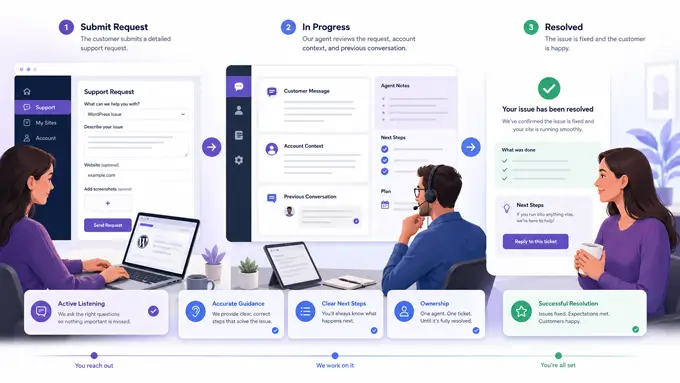
Excellent customer service means giving customers accurate, respectful and useful help with as little unnecessary effort as possible.
It does not always mean replying instantly or agreeing to every request. It means that you:
- understand the actual problem;
- explain the next step clearly;
- take ownership of the conversation;
- avoid making promises you cannot keep;
- provide realistic expectations;
- preserve important context;
- confirm whether the solution worked.
For example, a fast reply that asks a customer to repeat information already included in the ticket is not necessarily good service. A slightly slower reply that identifies the problem, explains the solution and sets a clear follow-up time may create a much better experience.
Teams should also know how to handle angry customers without becoming defensive or relying on generic apologies.
Why Is Customer Service Important for Every Business?
Customer service matters because it connects the promises made by your marketing and sales teams with the experience customers receive after taking action.
A polished website may attract a buyer, but the support experience often determines whether that person continues trusting the business when a question, delay or technical problem occurs.
The following eight reasons explain its wider effect.
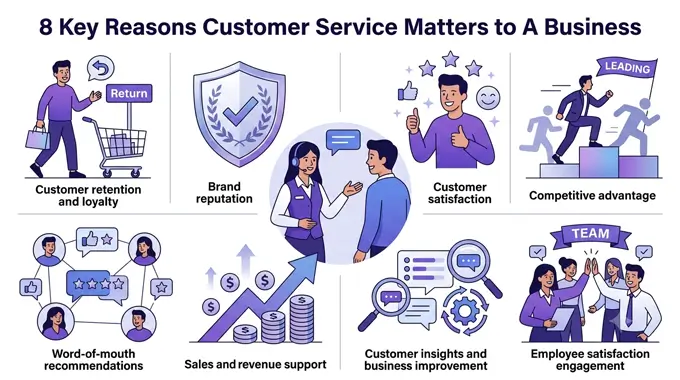
1. It Supports Customer Retention and Loyalty
Customers are more likely to continue a relationship when they can get useful help without repeating themselves, waiting without updates or being transferred without context.
Good service does not guarantee that every customer will stay. Pricing, product fit, competition and changing needs also affect retention. However, responsive and reliable support removes avoidable reasons for leaving.
Consider a WordPress plugin user who encounters an activation problem. If the support team reviews the account details, identifies the likely cause and provides ordered troubleshooting steps, the customer has a reason to remain confident. An irrelevant saved reply may have the opposite effect.
Support should therefore contribute to broader customer-retention strategies instead of operating as an isolated department.
2. It Protects Brand Reputation
Customers experience your brand through more than advertisements, design, and product features. They also judge how your business responds when something goes wrong.
A respectful resolution can reinforce trust. A dismissive answer, unexplained delay or broken promise can become the part of the experience the customer remembers most clearly.
This is especially important online because customers may share their experiences through reviews, community discussions and social media. Your support process should make sure that agents:
- understand the company’s policies;
- communicate those policies consistently;
- avoid blaming customers;
- document commitments;
- escalate serious issues appropriately.
Reviewing examples of bad customer service can help teams identify behaviors that quietly damage credibility.
3. It Improves Customer Satisfaction
Customer satisfaction is influenced by whether the customer can achieve the outcome they expected.
A customer may contact support because they want to complete a purchase, restore access, fix a technical error, understand a bill or confirm whether a feature meets their needs. The team’s job is not simply to send a reply. It is to help the customer move toward that outcome.
Satisfaction generally improves when support is:
- easy to access;
- relevant to the problem;
- written in clear language;
- consistent across agents;
- honest about limitations;
- followed through to resolution.
Teams can also improve difficult interactions by using accurate and situation-specific language. For instance, knowing when to say “thank you for your patience” can prevent a polite phrase from sounding automatic or dismissive.
4. It Creates a Competitive Advantage
Businesses often compete with alternatives that offer similar products, features or prices. Service can become a meaningful differentiator when customers know that help will be available after the purchase.
This can be particularly valuable for WordPress products. Customers may compare several plugins that appear to solve the same problem. Clear documentation, knowledgeable replies and dependable follow-up can reduce the perceived risk of choosing one solution over another.
A competitive support experience does not require making unrealistic promises. It requires consistency.
You can strengthen it by defining:
- which channels customers should use;
- what information agents need;
- which problems require escalation;
- how ownership is transferred;
- when customers receive updates;
- how resolved issues improve documentation.
These practices also support clearer customer-service objectives for the team.
5. It Encourages Word-of-Mouth Recommendations
Customers often recommend businesses that make them feel confident, especially when a company resolves a difficult problem fairly.
A recommendation is more credible when it comes from a real customer rather than directly from the company. However, businesses should not treat every support conversation as an opportunity to ask for a review.
The first priority is resolving the issue. After a successful outcome, you may invite feedback naturally when appropriate.
Positive word of mouth is more likely when the customer can describe something specific, such as:
- the team understood the problem quickly;
- an agent took responsibility;
- instructions were easy to follow;
- a promised update arrived on time;
- the company corrected an error fairly.
These experiences can also strengthen customer engagement beyond the original support request.
6. It Can Support Sales and Revenue
Why is Customer Service Important when sales teams already handle revenue? Because existing customers may need help before they can renew, upgrade, complete another purchase or continue using what they bought.
Support can remove barriers to revenue by:
- resolving checkout or account-access problems;
- answering presale questions accurately;
- clarifying product suitability;
- helping customers use purchased features;
- identifying when a customer needs a different solution;
- preventing avoidable cancellations.
This does not mean support agents should pressure customers into buying more. Recommendations should be based on the customer’s actual need.
For example, if a WooCommerce store owner asks whether a tool can support a particular workflow, the agent should explain the capability and its limitations clearly. Honest guidance protects trust even when the answer does not produce an immediate sale.
7. It Provides Customer Insights for Improvement
Support conversations reveal where customers struggle.
A single request may be an isolated question. Repeated requests about the same topic may indicate a broader problem, such as:
- unclear onboarding;
- missing documentation;
- a confusing interface;
- an unexpected product limitation;
- inconsistent policy wording;
- a broken website step;
- an unresolved technical defect.
Do not measure support only by how quickly tickets are closed. Review why customers make contact and what happens afterward.
Useful questions include:
- Which topics create the most requests?
- Which issues are repeatedly reopened?
- Where do customers abandon a process?
- Which searches return no useful documentation?
- Which instructions cause repeated confusion?
- Which problems require frequent escalation?
Knowledge-base analytics can help teams examine article views and customer searches instead of relying only on assumptions.
Customer insights should then lead to action. The response may be a documentation update, interface improvement, policy clarification, saved reply, training session or product fix.
8. It Supports Employee Satisfaction and Engagement
Poor support systems create unnecessary pressure for employees as well as customers.
Agents become frustrated when they cannot find accurate information, do not know who owns a request, receive conflicting instructions or repeatedly answer questions that should have been documented.
A better service operation gives employees:
- clear responsibilities;
- usable customer history;
- current documentation;
- realistic response expectations;
- defined escalation paths;
- reliable saved replies;
- authority to handle common situations;
- coaching based on real conversations.
This does not remove every difficult interaction. It makes those interactions easier to manage consistently.
Workload should also be reviewed before the team becomes overwhelmed. These signs that it may be time to hire a customer-support agent can help businesses distinguish a temporary increase in tickets from a long-term capacity problem.

How Can You Improve Customer Service in Practice?
Understanding Why is Customer Service Important is useful only when it changes how your team works.
Start with the following process.
1. Review recent conversations
Select a representative group of tickets, emails or chats. Look for situations where customers had to repeat information, wait without an update or ask what to do next.
2. Categorize recurring problems
Group requests by topic, urgency and cause. Separate product defects from documentation gaps, billing questions, account problems and general guidance.
3. Clarify ownership
Every request should have a clear owner. When escalation is necessary, transfer the history and explain who will respond next.
4. Improve documentation
Turn repeated questions into clear knowledge-base articles. Existing content can also be migrated from BetterDocs using the documented knowledge-base migration process.
AI can help prepare an initial documentation draft, but a knowledgeable person should verify the instructions before publication. See how to use Write with AI for knowledge-base articles.
5. Standardize without sounding robotic
Saved replies should provide structure, not replace judgment. Agents must update names, context, instructions, promises, and next steps before sending them.
AI prompt templates may help teams prepare clearer drafts. Review these AI prompt templates for customer service while keeping human review in the workflow.
6. Measure complete resolution
Track more than the first response. Review whether the issue was solved, reopened, transferred unnecessarily or followed by another request about the same problem.
7. Close the loop
Confirm whether the solution worked. Then record any lesson that could improve documentation, training, policy, or product design.
For customer-facing businesses, these steps can be combined with broader B2C customer-service practices.
A Simple Customer-Service Review Checklist
Before closing an important support request, ask:
- Is there a recurring problem that another team should investigate?
- Did we understand the customer’s desired outcome?
- Did we use the information already provided?
- Are the instructions complete and correctly ordered?
- Did we explain limitations honestly?
- Is the next action clear?
- Does someone own the follow-up?
- Did we provide a realistic update expectation?
- Have we confirmed that the issue is resolved?
- Should this conversation improve our documentation?
Read More:
👉 How Can You Measure Customer Satisfaction
👉 Top 10 Reasons Why Customer Satisfaction Is Important For Businesses
Using a Support System Without Losing the Human Element
A ticketing and knowledge-base system can help a team preserve conversation history, organize ownership, reuse approved information and make self-service content easier to find.
Technology should reduce avoidable administration, not replace accountability or judgment. Automated drafts and chatbots still need clear boundaries, accurate documentation and a path to a human agent when the issue is sensitive, complex or unresolved.
Support Genix can be considered by WordPress teams that need a combined support-ticket and knowledge-base workflow. Keep any product CTA separate from the eight editorial reasons so readers can distinguish educational guidance from product information.
Teams comparing operational options can also review customer-success management tools according to their size, workflow and reporting needs.
Support Genix
WordPress Support Ticket Plugin
Take Your Customer Support to The Next Level and Boost Customer Satisfaction Rates
Frequently Asked Questions
Can Poor Customer Service Affect Revenue?
Yes. Poor service can contribute to cancellations, abandoned purchases, negative recommendations, and lost repeat business. Its exact financial effect varies by business, customer value and the severity of the problem.
How Can WordPress Businesses Provide Better Service?
They can centralize customer history, organize ticket ownership, maintain accurate documentation, create escalation rules, and review recurring requests for product or content improvements.
Should Customer-Service Teams Use AI?
AI can assist with drafting replies, summarizing requests, and preparing documentation. Human review remains important for accuracy, tone, billing, refunds, privacy, security, account access, and unusual situations.
What Is the Difference Between Customer Service and Customer Support?
Customer service covers the broader relationship before, during and after a purchase. Customer support usually focuses more narrowly on solving product, account, order or technical problems.
What Is the Most Important Part of Customer Service?
The most important part is helping the customer reach a clear and appropriate outcome. Speed and politeness matter, but neither compensates for an inaccurate answer or an unresolved problem.
Why Is Customer Service Important for Small Businesses?
Small businesses often depend heavily on repeat customers, trust and recommendations. Reliable service can help them build stronger relationships and compete with larger companies even when they cannot match every price, feature or delivery option.
Conclusion
Why is Customer Service Important? Because it influences what happens after a customer becomes interested in your business. It shapes trust, retention, satisfaction, reputation, recommendations, revenue opportunities, organizational learning and the working experience of your support team.
Start by reviewing recent customer conversations. Find the moments where people had to repeat themselves, wait without information or ask what to do next. Fixing those points will create more value than adding another generic promise about excellent customer service.