Why a Customer Service Knowledge Base is Important?

Your support team answers the same questions dozens of times every single week consistently. Customers wait hours or even days for responses to urgent support inquiries daily. Support agents feel burned out from repetitive work and handle overwhelming ticket volumes constantly. Your costs keep climbing higher as ticket volume increases without proportional revenue growth increases.
A customer service knowledge base is important because it transforms your entire operational dynamic completely. It’s a centralized, searchable library of help articles, comprehensive guides, and instant answers available globally. Your customer service knowledge base provides 24/7 support without requiring human agents to respond manually always. The immediate result? Dramatic cost reductions, satisfied customers, and empowered support agents succeed.
The numbers prove why a customer service knowledge base is important for modern businesses today. 92% of consumers say they would use an online knowledge base for self-support if available immediately. Organizations that implement comprehensive knowledge bases see significant improvements across all metrics consistently.
Companies with mature knowledge management systems achieve 60% higher customer satisfaction scores compared to those without them. The data is clear: a customer service knowledge base is no longer optional anymore.
This comprehensive guide explores exactly why a customer service knowledge base is important and absolutely essential. We’ll examine the specific business benefits, implementation strategies, and how to maximize your knowledge base impact. By the end, you’ll understand the complete financial and operational case for investing now.
Support Genix
WordPress Support Ticket Plugin
Take Your Customer Support to The Next Level and Boost Customer Satisfaction Rates
Key Takeaways
- 92% of customers actively want knowledge bases available for self-service support
- Reduce support costs by 30% or higher immediately with effective implementation strategies
- AI knowledge bases cut support tickets by 40% automatically across all customer segments
- Scale support operations without hiring additional staff members or contractors today
- Achieve 60% higher customer satisfaction quickly by providing 24/7 instant answers
- Transform support from a cost center to a revenue driver through strategic optimization

Understanding Knowledge Bases: Defining the Core Concept
A customer service knowledge base is a centralized, searchable library serving customers and support agents. It contains help articles, FAQs, comprehensive guides, video tutorials, and detailed documentation for your product.
Customers access this library to find answers independently without contacting support representatives directly. Support agents access the same content to ensure consistent, accurate information across all channels.
Your knowledge base exists to solve customer problems independently without agent intervention. It reduces the support team’s workload significantly while providing instant answers around the clock consistently.
When implemented correctly, a knowledge base becomes your most valuable support asset available. The investment pays for itself quickly through ticket reduction and cost savings realized.
Five core components make a knowledge base effective and valuable for organizations:
- Content Library: Comprehensive articles, FAQs, guides, video tutorials, and multimedia content resources
- Smart Search Functionality: Natural language search, tag-based organization, and AI-powered result suggestions
- Intuitive Categorization: Well-organized content structure helps customers discover answers independently
- Regular Content Updates: Keeping information fresh, accurate, and aligned with current product features
- System Integration: Connecting seamlessly with chatbots, ticketing systems, CRM, and email platforms
Your knowledge base typically comes in two distinct types serving different operational purposes. An external knowledge base is public-facing and accessible to customers seeking self-service support answers.
An internal knowledge base serves your support team, providing training materials and reference documentation for consistency. Most successful organizations implement both types strategically for maximum organizational benefit.
The Complete Business Case for Customer Service Knowledge Bases
A customer service knowledge base represents one of the smartest investments your organization can make today. The business case is compelling, with multiple benefits that extend far beyond simple cost reduction metrics. Let’s examine each significant benefit with real data and specific examples throughout. Understanding these benefits helps your organization make the investment decision confidently.
Cost Reduction and ROI: Why Knowledge Bases Pay for Themselves
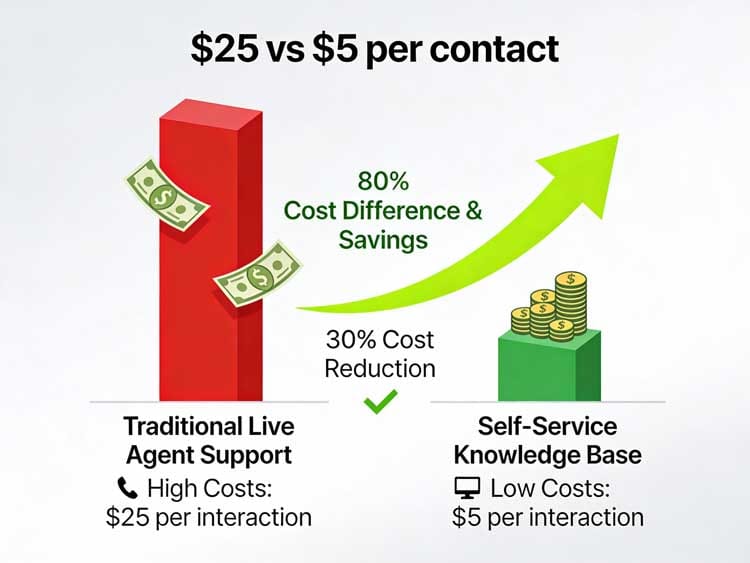
Your support costs drop dramatically when customers find answers independently without contacting agents. Live agent support costs approximately $25 per interaction, while self-service support costs only $5 per contact interaction. That’s an 80% cost difference that directly impacts your bottom line profitability.
Organizations reduce support costs by 30% or higher with effective self-service knowledge base implementation. Multiply your current cost per ticket by your monthly recurring question count. A 30% reduction typically pays for knowledge base implementation within the first business quarter. Most organizations see a return on investment within six months of launch.
Real ROI calculation for a typical organization: If you handle 2,000 support tickets monthly at a $12 per ticket average cost, that’s $24,000 monthly. A 30% reduction saves $7,200 monthly or $86,400 annually in support costs. A knowledge base solution typically costs $200-500 monthly, paying for itself within weeks consistently.
Every customer who finds an answer independently is a ticket your team doesn’t need to handle manually. This ticket deflection compounds monthly as more customers discover your knowledge base. The financial impact grows exponentially over time as customer adoption increases substantially.
Improving Customer Satisfaction Through 24/7 Instant Answers
81% of customers want more self-service options from companies today according to recent research. Customers expect instant answers, not responses delayed by hours or days typically. A knowledge base meets this expectation by providing immediate responses without waiting involved whatsoever.
77% of consumers have used a self-service support portal when seeking help previously. This demonstrates that customers are comfortable and familiar with self-service support channels. They actively prefer self-service options when available because they get faster resolution times always.
Response time drops from 36+ hours average to instantaneous with a comprehensive knowledge base. Customers receive immediate answers instead of waiting in phone queues or email backlogs indefinitely. This dramatically improves the customer experience and satisfaction scores measurably.
Live chat achieves 87% customer satisfaction versus 44% for phone support interactions. Self-service support scores even higher because customers solve problems independently without any wait time.
Customer effort score decreases significantly, meaning customers spend less energy getting the support they need. Satisfied customers stay longer, buy more products, and recommend you to potential customers.
Reducing Support Ticket Volume and Team Burnout
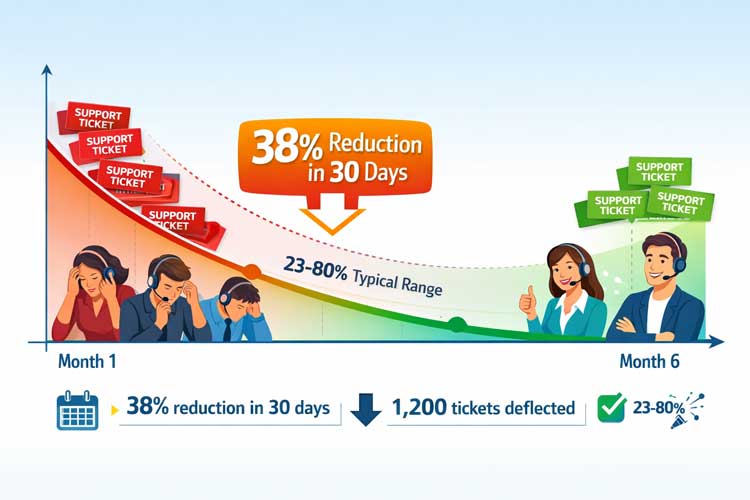
Knowledge bases reduce support tickets by 23-80% depending on implementation quality and execution. The range demonstrates the importance of high-quality content and smart system implementation strategies. Real-world examples show exactly what’s possible with proper planning and execution.
One eCommerce brand saw 38% ticket drop within 30 days of launching a comprehensive FAQ widget. Another brand deflected 1,200 customer order status tickets in one month alone by creating tracking guides. These aren’t theoretical numbers—they’re real results from actual implementations across industries.
Support teams handle 3x more tickets per day with modern self-service systems in place. Automatic routing and AI-powered suggestions save 15-20 hours per week per team member. Your agents spend less time answering repetitive questions and more time solving complex problems.
Your agents feel more engaged and challenged when handling only complex issues instead of repetitive ones. Job satisfaction improves noticeably, reducing turnover and the associated costs. Replacing a single support agent costs approximately $10,000 in recruiting, training, and productivity losses.
Enabling Scalable Support Without Proportional Hiring
Your business grows rapidly, but your support team size doesn’t need to grow proportionally anymore. Self-service systems handle unlimited users simultaneously without additional staff or infrastructure costs. Support capacity grows exponentially without hiring more agents or contractors.
A SaaS company with 10,000 new customers doesn’t need 20 new support agents necessarily. The knowledge base scales with customer growth automatically, handling increased inquiry volume without human scaling. This is the power of intelligent self-service automation systems.
AI chatbots powered by your knowledge base handle routine ticket handling automatically for efficiency. 40% reduction in agent workload is common when implementing AI-assisted support systems. Your organization scales to enterprise size without necessarily tripling support team expenses.
Building Brand Authority and Customer Trust
A comprehensive knowledge base positions your organization as an industry expert and trusted authority. Well-organized, detailed content demonstrates complete product mastery to potential customers viewing. Customers perceive businesses with strong support resources as more trustworthy and reliable. Authority in support translates directly to authority in product quality and business reputation.
Repeat visitors build confidence in your solutions through positive self-service support experiences consistently. Potential customers viewing your knowledge base see sophisticated support infrastructure before purchase. This confidence translates to higher conversion rates and lower churn among existing customers.
Companies with excellent service experience have 2.4x more revenue growth than industry averages do. The connection between support quality and business growth is undeniable and well-researched. Your knowledge base becomes a competitive advantage, not just an operational necessity.
Actionable Data for Product Development
Your knowledge base analytics reveal the most-searched topics and common customer pain points immediately. Zero-result searches show critical content gaps and unmet product needs requiring attention. Popular articles indicate customer priorities and what matters most to your customer base. This behavioral data guides your product roadmap and development priorities effectively.
If customers search 1,200 times monthly for shipping tracking help, that’s a product gap. Your analytics reveal that this feature is important to customers even before they request it. This data-driven approach to product development prevents building unnecessary features. You focus resources on improvements customers actually want and need.
Support data becomes competitive intelligence about market trends and changing customer expectations. What customers ask about reveals industry shifts before they become obvious to competitors. Your knowledge base transforms support from a cost center to a strategic business intelligence resource.
Empowering Support Agents with Complete Knowledge
Agents access consistent, verified information instantly without searching across multiple systems manually. Training time for new support hires reduces 30-40% with centralized knowledge base reference material.
First-contact resolution rates improve to 75%+ when agents have comprehensive information access. Your agents feel confident handling complex issues because they have complete information available.
No more searching across 10 different systems, outdated documentation, or conflicting information sources. Centralized knowledge eliminates confusion and ensures every customer receives consistent, accurate answers. Agents become solution experts, not information hunters wasting precious time searching systems.
Your team provides better customer service when they have comprehensive, organized knowledge available. Agent morale improves, satisfaction increases, and retention rates improve significantly over time. Your support team becomes a competitive advantage, not just a cost center anymore.
AI-Powered Intelligence: Knowledge Bases Meet Modern Technology
AI-powered knowledge bases reduce support tickets by up to 40% automatically across all interactions. Smart search uses natural language understanding, interpreting customer questions like a human would. Predictive analytics suggest relevant articles before customers even realize they need help. Machine learning improves search results continuously as the system learns from customer behavior patterns.
80% of customer service organizations will use generative AI by 2025, according to industry predictions. Your knowledge base, powered by AI, becomes smarter every single day automatically. The system learns from customer behavior and continuously improves suggestions and search results. AI transforms your knowledge base from static to dynamic and increasingly intelligent.
ChatGPT-powered support systems combine your knowledge base with conversational AI capabilities effectively. Customers interact naturally with the system, receiving accurate answers from your verified content.
AI handles 95% of routine interactions by 2025, according to industry forecasts. Your support team focuses exclusively on complex issues requiring human judgment.
Multi-Channel Support Consistency
Knowledge base content powers your chatbots, email signatures, live chat, and website help systems. Your customer receives the same accurate answer via email, chat, phone, or website access.
Consistent messaging across all channels significantly builds confidence in your support quality. Seamless escalation from self-service to human agents provides an excellent omnichannel experience.
Omnichannel experience increases customer engagement by 252% compared to single-channel support. A unified customer experience across all touchpoints builds lasting loyalty and satisfaction consistently.
Your agents access the same content customers see, ensuring perfect consistency always. This alignment creates a powerful support system that works seamlessly together.
Common Pitfalls and Advanced Strategies for Maximum Impact
Many organizations launch knowledge bases but fail to maximize their potential and benefits. Understanding common mistakes helps you avoid them and succeed from day one. Advanced strategies take your knowledge base from good to exceptional and highly effective. Let’s explore both to ensure your implementation succeeds completely.
Common Pitfalls: What Fails and How to Fix It
Pitfall 1:
Outdated Information: Content becomes stale, and customers lose trust in your system.
Fix: Review and update all content at a minimum of quarterly, ideally monthly, consistently.
Pitfall 2:
Poor Organization: Articles are buried in confusing category structures that customers can’t navigate.
Fix: Organize content by customer journey and problems, not by internal department structure.
Pitfall 3:
Weak Search Functionality: Users can’t find answers; search yields irrelevant results.
Fix: Invest in an AI-powered search engine with built-in natural language processing.
Pitfall 4:
Insufficient Content: The knowledge base was launched with only 10 articles when customers have 100 questions.
Fix: Start with your top 50 customer questions before launching your knowledge base.
Pitfall 5:
No Analytics Tracking: Implementing without measuring impact or knowing what works.
Fix: Track searches, click-through rates, customer satisfaction, and ticket deflection rates.
Pitfall 6:
Ignoring Agent Input: Neglecting support team feedback about what customers actually ask.
Fix: Use real support tickets as source material for your knowledge base content.
Advanced Strategies: What Works Best
Strategy 1:
Content-from-Tickets Approach: Use actual support tickets as your source material always. Replicate customer language in articles, not corporate jargon or technical terminology. If customers email “where is my stuff?” use exactly that phrase in article titles.
Strategy 2:
Zero-Result Search Optimization: Monitor searches that return nothing, revealing critical content gaps. Create articles for these missing topics immediately to capture customer intent. This data-driven approach ensures you create content customers actually need.
Strategy 3:
Article Performance Analytics: Track which articles drive traffic, which achieve self-service completion, which lead to tickets. Double down on high-performers and improve or remove underperformers ruthlessly. Use data, not assumptions, to guide content improvements.
Strategy 4:
Proactive Personalization: Use AI to suggest relevant articles based on customer behavior and history. Show personalized suggestions on your website based on what page customers view. Increase self-service resolution through smart content recommendations.
Strategy 5:
Intelligent Chatbot Integration: Deploy AI chatbots pulling directly from your knowledge base content. Let bots handle common questions efficiently; escalate complex issues smoothly to agents. This integration maximizes ticket deflection while maintaining quality consistently.
Strategy 6:
Agent Training Transformation: Use your knowledge base as the primary agent training tool for new hires. New employees learn from verified, up-to-date content instead of inconsistent mentor explanations. Onboarding time decreases significantly while quality improves considerably.
Strategy 7:
Continuous Improvement Workflow: Include “Report an Error” links on every article in your knowledge base. Act on feedback within 48 hours, showing customers you’re responsive to their needs. This feedback loop ensures content stays accurate and helpful always.
Manage Customer Support with Unlimited Tickets
Seamlessly manage customer support, respond promptly, and foster customer loyalty. Elevate your business’s reputation and satisfaction levels today.
- Unlimited Tickets
- Unlimited Users
- Data Analysis Reports
- WooCommerce Integrations
- WebHook Integrations
- Unlimited Email Piping
Frequently Asked Questions
Why should my company invest in a knowledge base today?
Knowledge bases reduce support costs by 30%, improve customer satisfaction significantly, and enable 24/7 support availability. Most organizations see return on investment within six months from launch date. The financial and operational benefits are compelling and well-documented in industry research.
How much does support ticket volume decrease with implementation?
Organizations typically see 23-80% reduction depending on implementation quality and content comprehensiveness. Real brands report 38-40% reduction within 30 days of launching their knowledge base. Results depend on content quality, organization, and how effectively you promote the knowledge base.
What content should I include in my customer service knowledge base?
Include FAQs, troubleshooting guides, product documentation, step-by-step how-to articles, video tutorials, and billing information. Add account management guides, shipping information, and any content helping customers use your product successfully. Start with your top 50 customer support questions based on ticket data.
How do I measure if my knowledge base is actually working effectively?
Track article views, search queries, zero-result searches, support ticket volume, customer satisfaction, and first contact resolution rates. Compare these metrics month-over-month to identify trends and improvement opportunities. Use data to guide continuous optimization and content improvements.
Can artificial intelligence improve my existing knowledge base significantly?
Yes, absolutely. AI-powered search, chatbots, and predictive analytics dramatically improve knowledge base performance. AI chatbots reduce tickets by 40%, and 80% of support organizations now use AI technology. Generative AI and machine learning capabilities are transforming support infrastructure today.
Conclusion
A customer service knowledge base is no longer optional infrastructure—it’s essential for modern business success. Organizations investing in comprehensive, well-organized knowledge bases see dramatic improvements consistently across metrics. Costs drop significantly, customer satisfaction soars, support teams become more efficient, and scaling becomes easier.
Your immediate wins from implementing a knowledge base include:
- Reduce support costs by 30% or higher through ticket deflection strategies
- Improve customer satisfaction by 60% through instant answers and 24/7 availability
- Decrease support tickets by 23-80%, depending onthe implementation quality carefully
- Enable 24/7 instant customer support without proportional hiring requirements
- Build brand authority and trust through comprehensive support resources
- Empower your support team to handle complex issues instead of repetitive ones
- Leverage AI for intelligent automation and continuous improvement systems
The investment pays for itself quickly, typically within the first business quarter after launch. Competitors are already building knowledge bases while your customers expect them as standard. The question isn’t whether you should build a knowledge base—it’s when you’ll start implementation.
Ready to transform your customer support operations today? Explore the SupportGenix Knowledge Base Solution designed specifically for businesses like yours. Our platform helps you reduce support costs, improve customer satisfaction, and enable 24/7 self-service support with AI-powered automation. Advanced analytics show you exactly what’s working and what needs improvement.
Start your knowledge base journey today by scheduling a consultation with our support specialists. Discover how thousands of businesses have already transformed their support operations successfully. Your customers—and your bottom line—will thank you for this strategic investment.