What is High Touch Customer Service? (Clear Definition + Real Examples)

Quick Answer:
High touch customer service is a personalized, human-led support model. It focuses on building one-on-one relationships with customers. Instead of automated responses, a real person handles each interaction. It is common in B2B, SaaS, luxury, and high-value retail sectors. The goal is to make every customer feel known, valued, and supported.
What is High Touch Customer Service? It is an individualized level of customer service that emphasizes personal relationships and achieving a personalized customer experience.
Most support teams are built for speed. They aim to close tickets fast and handle high volume. That works — but only for a certain kind of customer.
High-value customers, complex B2B accounts, and first-time buyers in competitive markets need something different. They need to feel like a person, not a ticket number.
That is exactly what high-touch customer service delivers. This guide explains what it is, how it differs from low-touch support, and how to put it into practice — without burning out your team.
Table of Contents
What Does High-Touch Customer Service Mean?

High-touch customer service means your team gives direct, personalized attention to each customer. There are no scripted replies or generic email blasts. Every interaction is tailored to the individual — their goals, history, and specific situation.
Think of it as the opposite of self-service. Instead of pointing a customer to a knowledge base, you walk them through it yourself.
Common examples of high touch customer service include:
- A dedicated account manager who knows your business goals
- Proactive check-ins before a customer even raises a problem
- Personalized onboarding calls for new users
- Direct phone access to a named support representative
- Follow-up emails with recommendations based on usage data
These are not extras. For high-value customers, they are the baseline expectation.

High Touch vs. Low Touch Customer Service
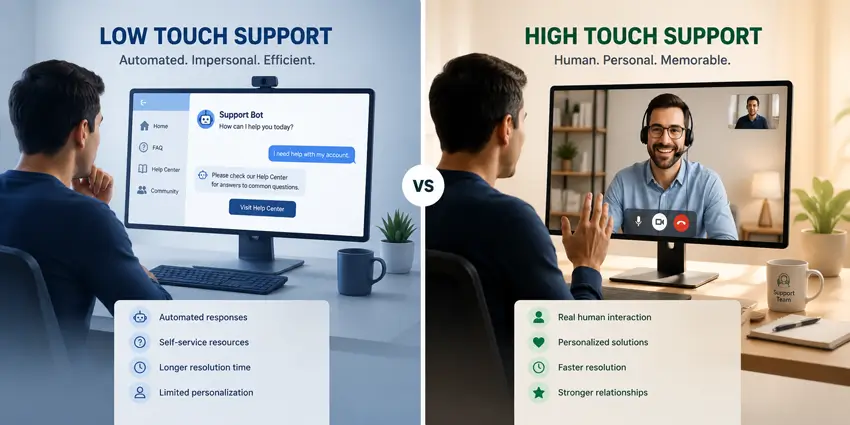
Understanding the difference helps you decide which approach fits which customer segment.
High-touch customer service:
- Involves frequent, direct human contact
- Assigns a named rep or customer success manager
- Personalizes every interaction based on customer data
- Anticipates problems before customers report them
- Best suited to high-value, complex, or long-term accounts
Low touch customer service:
- Relies on automation, self-service, and standardized replies
- Works through chatbots, FAQ pages, and knowledge bases
- Scales easily across large customer bases
- Best suited to transactional, low-cost, or simple accounts
Key insight: Most successful companies do not choose one or the other. They use low-touch support for routine queries and high-touch service for the accounts that drive the most revenue.
Read More:
1. 10 Copy-Paste AI Prompt Templates for Fast Customer Service Responses
2. 30+ customer service email templates and best practices for contacting customers
3. Top 10 Objectives on a Resume for Customer Service(With Examples)
4. Sales and Customer Service: The Two Pillars of a Successful Business
Why High Touch Customer Service Matters
Personalized service is not just a nice-to-have. The numbers back it up.
- 88% of customers say they want brands that offer personalized experiences (Vitally Industry Survey)
- 50% of SaaS users log in less than once per month — proactive high-touch outreach directly addresses this
- Brands that personalize well are 71% more likely to see higher customer loyalty (McKinsey)
- Customer success teams using high-touch models report lower churn and higher lifetime value
The business case is clear. When customers feel known and valued, they stay longer, spend more, and refer others.
Specific benefits for your business:
- Higher retention: Proactive service builds trust before issues arise.
- Stronger loyalty: Customers who feel valued do not compare prices as often.
- Better feedback: Customers in close relationships share honest input more freely.
- Upsell opportunities: Account managers spot growth needs before customers ask.
- Competitive advantage: Personalized care is hard for competitors to copy at scale.
When Should You Use High Touch Customer Service?
Not every customer needs this level of attention. High touch service is most valuable in specific situations.
Use it when:
- The customer represents significant revenue. Enterprise accounts or multi-year contracts justify the investment.
- The product is complex. SaaS tools, B2B services, and technical platforms need guided adoption.
- The purchase is emotional or high-stakes. Real estate, healthcare, luxury retail, and financial services all qualify.
- A customer shows signs of churning. Reduced login activity or negative feedback signals the need for human outreach.
- Onboarding is a critical phase. The first 30 to 60 days define long-term retention in most subscription products.
For lower-value or simple-use accounts, a well-built knowledge base and responsive ticketing system is usually enough.
How to Implement High Touch Customer Service: 6 Practical Steps
Putting high touch service into practice takes more than good intentions. Here is a clear framework to follow.
Step 1: Segment your customers by value and complexity
Not all customers qualify for high-touch service. Use CRM data, purchase value, and engagement history to identify your top 10 to 20 percent. These are your high-touch accounts.
Step 2: Assign dedicated account managers or CSMs
Each high-value customer should have a named point of contact. This person owns the relationship — not a ticket queue. Consistency builds trust faster than anything else.
Step 3: Build a proactive check-in schedule
Do not wait for customers to reach out with problems. Schedule monthly or quarterly calls. Use usage data to drive the agenda. Show them you are watching their results, not just waiting for support tickets.
Step 4: Personalize every touchpoint
Use customer history to make every email and call feel tailored. Reference their setup, their industry, their past conversations. Generic responses have no place in a high-touch model.
Step 5: Create feedback loops and act on them
Ask for input regularly and respond to it visibly. When a customer sees their feedback change how your product or service works, their trust deepens significantly.
Step 6: Use tools to support — not replace — the human element
A good customer support ticketing system helps your team track conversations, spot at-risk accounts, and maintain context across every interaction. The tool enables the human; it does not replace them.
Strategies to Scale High Touch Service Without Burning Out Your Team
The most common objection to high touch service is cost. Personalized support is time-intensive. But there are ways to maintain quality at scale.
- Tier your accounts clearly: Reserve your highest-touch resources for your top-tier customers only. Be ruthless about this.
- Use automation for the routine parts: Automate appointment reminders, usage reports, and renewal alerts. Save human time for conversations that actually need a person.
- Create playbooks for your CSMs: Standardize what a check-in call covers, what triggers escalation, and what a healthy account looks like. Consistency improves quality across the team.
- Build a strong self-service layer underneath: A knowledge base, FAQ section, and video tutorials handle common questions automatically. This frees your team for genuine high-touch work.
- Track health scores proactively: Monitor login frequency, ticket volume, and NPS. Flag accounts showing warning signs before the customer feels the need to complain.
High Touch Customer Service Examples in Practice
Seeing real examples makes the concept concrete.
B2B SaaS onboarding:
A customer success manager contacts a new enterprise client within 24 hours of signup. They schedule a personalized setup call, provide a tailored implementation checklist, and schedule a 30-day review. The customer never feels left to figure things out alone.
Luxury retail:
A personal shopper contacts a regular client before a new collection arrives. They remember her preferences, budget, and upcoming event. The customer does not browse — she receives a curated shortlist.
WordPress support plugin:
A plugin company using Support Genix assigns priority ticket routing for their top-tier agency clients. Every request from a high-value account gets routed to a senior agent, not the general queue. Response times drop. Satisfaction scores rise.
Support Genix
WordPress Support Ticket Plugin
Take Your Customer Support to The Next Level and Boost Customer Satisfaction Rates
Frequently Asked Questions
What is the difference between high touch and low touch customer service?
High touch customer service uses direct, personal, human-led interactions. It is designed for complex or high-value customers. On the other hand, low-touch customer service relies on automation, self-service tools, and standardized responses. It scales across large, transactional customer bases.
Is high-touch customer service only for enterprise companies?
No. Any business with high-value clients or complex products can benefit. Freelancers, agencies, SaaS startups, and small businesses all use high touch models for their most important accounts.
How do you measure the success of high touch customer service?
Track customer retention rate, churn rate, Net Promoter Score (NPS), customer lifetime value (CLV), and response time for high-touch accounts. Compare these against your low-touch segment to see the impact clearly.
What tools support a high touch customer service model?
A customer support ticketing system is the foundation. It helps teams track conversations, assign accounts, flag at-risk customers, and maintain full context across every interaction. CRM tools, health score dashboards, and scheduling software also play supporting roles.
Can high touch customer service work for WordPress plugin businesses?
Yes. WordPress plugin businesses with agency clients or enterprise users benefit significantly. Assigning priority support, proactive onboarding calls, and dedicated ticket routing for top accounts can increase renewals and reduce churn meaningfully.
Final Thoughts
High touch customer service is not about doing more for everyone. It is about doing the right things for the customers who matter most to your business.
When done well, it turns customers into advocates. It reduces churn. It increases lifetime value. And it creates relationships that competitors cannot easily disrupt with a lower price.
The starting point is simple: identify your highest-value accounts, assign a named point of contact, and commit to proactive outreach. The rest follows from there.
If your team is handling support requests through email or a disorganized inbox, that is the first thing to fix. A structured ticketing system gives your team the visibility they need to deliver genuinely personalized service at scale.