What Is Customer Success Advocacy? Benefits, Examples, and How to Build It

Quick Answer: Customer success advocacy is the practice of helping successful customers become willing advocates for your company. Advocacy can include reviews, referrals, testimonials, case studies, reference calls, community posts, and product feedback. The strongest programs help customers reach real results first. Only then do they ask customers to share their experience.
Customer success advocacy turns satisfied customers into people who speak up for your business. It starts after a customer gets real value from your product. Then you give them easy, voluntary ways to share that experience.
Many teams mix this up with customer success itself. The two are linked, but they are not the same thing. This guide explains the difference and shows what advocacy looks like in practice.
You will also learn how to build a program, spot likely advocates, and measure results. A short section covers mistakes that quietly damage customer trust.
Table of Contents
What Is Customer Success Advocacy?
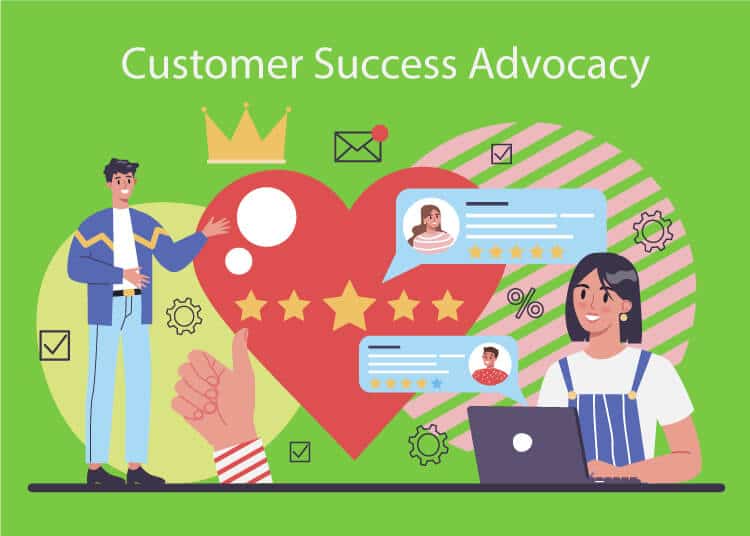
Customer success advocacy connects two jobs. The first is helping customers reach their goals with your product. The second is inviting happy customers to share what they achieved.
Think of it as a simple chain of cause and effect:
Customer success → customer value → trust and loyalty → advocacyAdvocacy is voluntary by design. A customer who feels pushed is not an advocate. They are simply doing a favor they did not want to do.
Several teams share this work. Support agents see customer problems first and can resolve them quickly. Customer success representatives guide adoption and check progress. Marketing and sales then use the stories that follow.
Support Genix
WordPress Support Ticket Plugin
Take Your Customer Support to The Next Level and Boost Customer Satisfaction Rates
Customer Success vs. Customer Advocacy: What Is the Difference?
Customer success helps customers reach the outcomes they bought your product to achieve. Customer advocacy happens when those customers choose to recommend you. One creates the result. The other shares it.
| Customer success | Customer advocacy | |
|---|---|---|
| Main goal | Help customers achieve outcomes | Encourage successful customers to share their experience |
| Focus | Adoption and value | Recommendations and customer voice |
| Examples | Onboarding, training, check-ins | Reviews, referrals, testimonials, case studies |
| Main result | Retention and success | Trust, proof, and word of mouth |
Advocacy also differs from customer experience. Customer experience covers every touchpoint between a customer and your company. Advocacy is one possible result of a good experience.
For a deeper look at the discipline behind this work, read our guide to customer success.

How Customer Success Turns Customers Into Advocates
Customers rarely recommend a product they still struggle to use. Advocacy usually grows through five stages:
- Onboarding: A smooth start shows customers how to reach their first result.
- Adoption: Customers begin using the features that match their goals.
- Value realization: They see a clear benefit, such as time saved or fewer errors.
- Positive experience: Your team stays responsive whenever an issue comes up.
- Advocacy: Satisfied customers become open to sharing what they gained.
Notice that advocacy comes last. Asking too early skips the value stage, and customers can tell. Personal guidance, as in high-touch customer service, gives your team more chances to build that trust.
What Does Customer Advocacy Look Like?
Advocacy takes many forms. Some take a minute. Others need real commitment from the customer.
- Customer reviews: Public ratings on review sites or plugin directories.
- Referrals: Introductions to people who have the same problem.
- Testimonials: Short quotes about the result the customer achieved.
- Case studies: Detailed stories that show the situation before and after.
- Reference calls: Conversations with prospects who are considering a purchase.
- Webinars and events: Live sessions where customers explain how they work.
- Community participation: Answering questions from other users.
- User-generated content: Tutorials, posts, or videos made by customers.
- Product feedback: Advisory groups that help shape your roadmap.
The Customer Advocacy Ladder
Not every customer is ready for every request. A ladder helps you match the ask to the relationship. Start at level one and move up only after a customer says yes to the step below.
| Level | Stage | Example activities |
|---|---|---|
| 1 | Feedback | Survey replies, product suggestions, support feedback |
| 2 | Validation | Ratings and written reviews |
| 3 | Recommendation | Referrals and personal recommendations |
| 4 | Storytelling | Testimonials, case studies, webinars |
| 5 | Partnership | Advisory boards, speaking slots, community leadership |
prioritize the needs of their customers through effective communication, marketing, and customer service initiatives.
Customer Success Advocacy allows businesses to build relationships with customers that last—relationships that often result in long-term success for the business. Customer-centric businesses that invest in this program are well-positioned for a sustainable and profitable future.
Customer Advocacy Examples
Example 1: A software customer
Imagine a customer who has used your software for nine months. They adopted several core features, renewed their plan, and often praised your support team. Do not ask for everything at once. Build up in steps:
- Ask whether they would leave a short review.
- Later, invite them to share a brief testimonial.
- If they stay engaged, offer a case study or webinar slot.
- Eventually, invite them to an advisory group.
Example 2: A WooCommerce store owner
Imagine a store owner who opened three tickets in two months. Each issue was solved in one clear reply. When the third ticket closes, your agent thanks them and asks if they would share their experience in a review. The ask feels natural because the help just happened.
EDITOR NOTE: Both examples are illustrative scenarios, not real customers. Do not present them as case studies.
Benefits of Customer Success Advocacy
Higher retention and loyalty
Customers who reach their goals have fewer reasons to leave. Pair advocacy with proven customer retention strategies to protect that gain.
Stronger social proof
Reviews, testimonials, and case studies reduce doubt for new buyers. They often feel more believable than your own marketing copy.
More referrals
A satisfied customer can introduce you to peers with the same problem. These leads often arrive with some trust already built.
Better product feedback
Engaged advocates tend to share detailed, honest input. Use it alongside other types of customer feedback to guide your roadmap.
Stronger customer relationships
Advocacy gives customers a bigger role in your story. That deepens customer loyalty beyond the product itself.
Better team alignment
Customer stories give success, sales, and marketing one shared source of proof. Everyone works from the same real results.
How to Identify Potential Customer Advocates
A customer should become an advocacy candidate only after they achieve meaningful value. Look for signals first, then confirm with a conversation.
Signals to look for
- High satisfaction scores or warm survey comments
- Strong adoption of the features tied to their goals
- Long tenure and repeated renewals
- Unprompted praise in emails, tickets, or social posts
- Positive support interactions and quick resolutions
- A history of referrals or helpful feedback
How to collect those signals
- Ask during onboarding what result made them buy.
- Record that goal in your customer notes.
- Review feature usage against the stated goal.
- Read support conversations for praise and repeat problems.
- Run short surveys to measure customer satisfaction.
- Note each milestone the customer reaches.
Do not rely on one signal alone. A pleasant support chat does not prove long-term value.
[Retain original banner image 2: alt “support genix support ticket plugin for woocommerce” – link: https://wordpress.org/plugins/support-genix-lite/?utm_source=sg-website&utm_medium=blog-post&utm_campaign=banner]
How to Build a Customer Advocacy Program
1. Define your objectives
Pick one or two goals, such as more reviews or more reference calls. Write each goal with a target and a date.
2. Identify successful customers
Use the signals above to build a short list. Start small so every request gets personal attention.
3. Decide which opportunities to offer
Match each activity to a rung on the ladder. A new customer gets a review request, not a speaking slot.
4. Ask at the right moment
Ask right after a clear win. Good moments include a resolved ticket, a finished setup, or a smooth renewal. Learn what else drives happy customers in our guide on how to improve customer satisfaction.
5. Make participation easy
Send a direct review link or a short form. Keep the request to one clear action. Never write a review on the customer’s behalf.
6. Give value back
Thank advocates publicly or privately. Offer early access, product input, or credit for their story. Keep any reward honest and disclosed.
7. Coordinate your teams
Keep one shared list of advocates, past requests, and dates. A spreadsheet works at first. Later, consider one of the customer success tools built for this job.
8. Track results
Review your metrics on a fixed schedule. The next section shows what to measure.
9. Avoid advocate fatigue
Set a limit on how often one customer can be approached. Rotate requests so the same enthusiastic people are not always asked.
Who does what on your team
- Support agents: Resolve issues quickly and flag customers who show real enthusiasm.
- Customer success managers: Own the relationship and choose the right timing.
- Marketing: Turn approved stories into case studies, quotes, and posts.
- Sales: Request reference calls only when a prospect truly needs one.
Train each group on these roles before launch. Review the plan together after the first quarter, then adjust.
How to Measure Customer Advocacy
Satisfaction scores alone do not show advocacy. You need metrics tied to real actions.
| Goal | Metric to track |
|---|---|
| Grow your advocate base | Number of active advocates |
| Increase participation | Share of invited customers who say yes |
| Build social proof | Reviews, testimonials, and case studies collected |
| Support sales | Reference calls completed |
| Drive acquisition | Referrals received and referrals that convert |
| Keep people engaged | Advocacy activities per advocate |
| Show business impact | Pipeline or revenue linked to advocacy |
| Protect relationships | Request frequency per customer |
Track outcomes, not only activity. Ten reviews from your ideal buyers matter more than fifty from people who never used the product.
Common Customer Advocacy Mistakes
- Asking too early: The customer has not seen value yet.
- Treating advocates as free marketers: Give something back for their time.
- Over-contacting advocates: Too many requests wear down goodwill.
- Offering rewards without real value: Empty perks feel like a bribe.
- Ignoring unhappy customers: Learn how to respond to customer feedback before you ask for praise.
- Not closing the loop: Tell advocates how their input changed your product.
- Measuring only activity: Count results, not just requests sent.
Ethics and Compliance in Customer Advocacy
Advocacy only works when it is honest. Keep every request voluntary, transparent, and respectful of the customer’s time. Reviews should reflect real experience.
Rewards need extra care. In the United States, endorsement and review rules expect clear disclosure of incentives. They also do not allow tying a reward to a positive review. Rules differ by country, so check the laws where you operate.
When You May Not Need a Formal Advocacy Program
A full program is not always the right move. Skip it, or keep it light, in these cases:
- You have only a handful of customers. Personal, informal asks work better.
- Most customers have not reached value yet. Fix onboarding first.
- Known product problems still cause frustration. Advocacy will not hide them.
- Your team cannot follow up. A half-run program hurts trust.
How Customer Support Contributes to Customer Advocacy
Support is often where advocacy is won or lost. A customer can love a product and still leave after one bad support experience.
- Every support interaction shapes the customer’s overall experience.
- Fast, organized resolution stops friction from undoing earlier success.
- Ticket history gives your team context before they reply or reach out.
- Recurring tickets reveal needs that surveys often miss. A voice of the customer approach helps you act on them.
- Support and success teams should share what they learn each week.
If you run support on WordPress, a support ticketing system such as Support Genix keeps conversations and ticket history in one place. Customers can also view the tickets they have submitted. That helps your team reply consistently and spot repeat issues early. It also improves how you support current customers day-to-day.
Frequently Asked Questions
What is customer success advocacy?
Customer success advocacy is the practice of helping customers reach their goals, then inviting satisfied ones to recommend your company. They may leave reviews, give referrals, share testimonials, or join case studies. It depends on real results and voluntary participation.
What is the difference between customer success and customer advocacy?
Customer success helps customers achieve the outcomes they want from your product. Customer advocacy happens when happy customers share that experience with others. Success comes first, and advocacy often follows when the customer feels real value.
What does a customer advocate do?
A customer advocate speaks up for your company by choice. They may write a review, refer a peer, join a reference call, or give product feedback. Some also take part in webinars or community discussions. Their words carry weight because they are genuine.
How do you identify customer advocates?
Look for customers who use key features, renew often, and give warm feedback. Unprompted praise and positive support experiences are strong signs. Confirm interest with a short conversation before you ask for anything, so the request feels welcome rather than sudden.
What are examples of customer advocacy?
Common examples include public reviews, referrals, testimonials, and case studies. Others include reference calls, webinar appearances, community answers, and customer advisory groups. Each one shows prospects how real customers use and value your product.
How do you measure a customer advocacy program?
Track active advocates, participation rates, reviews, referrals, and completed reference calls. Add advocacy-influenced pipeline if your sales team can record it. Also watch how often each customer is contacted, so you can protect relationships and avoid fatigue.
When should you ask a customer for a review or referral?
Ask soon after a clear win, such as a solved issue, a completed setup, or a smooth renewal. The experience is fresh, and the customer has a reason to speak up. Avoid asking during an unresolved problem or before they see value.
Conclusion
Customer success advocacy starts with results, not requests. Help customers win first. Then offer simple, honest ways to share the experience.
Begin small this month. Pick one goal, list five likely advocates, and ask one of them for a review. Track the response and adjust from there. If you want to strengthen the base underneath, start with building customer relationships and a clear view of why customer satisfaction matters.