What Is Customer Success? (And How It’s Different from Customer Support)

Customer success is a proactive strategy focused on helping customers achieve their goals with your product so they stay, grow, and advocate for you. Customer support is reactive, stepping in when something breaks or a customer raises an issue.
Customer success vs customer support is one of the most important distinctions for modern SaaS and WordPress businesses. Getting it right directly affects churn, revenue, and the lifetime value of every customer.
Table of Contents
Customer Success vs. Customer Support: The Core Difference

Customer support is reactive: a customer runs into a problem and contacts your team for help.
Customer success is proactive: your team reaches out first to make sure the customer is getting real value from what they paid for.
Think of it this way: support puts out fires. Customer success prevents them.
| Customer Support | Customer Success | |
|---|---|---|
| Approach | Reactive | Proactive |
| Goal | Resolve issues | Drive long-term value |
| Trigger | Customer initiates | Team initiates |
| Metric | Resolution time, CSAT | Churn rate, NRR, CLV, renewal rate |
| Timeframe | Per-interaction | Ongoing lifecycle |
Both functions matter, but customer success is increasingly what separates growing businesses from stagnant ones.
Why Customer Success Matters for Your Business
A 5% increase in customer retention can boost profits by 25% to 95%, according to Bain & Company research. That is the direct business case for investing in customer success.
The global Customer Success Platforms market was valued at approximately $1.86 billion in 2024 and is projected to reach $9.17 billion by 2030: a clear signal that businesses at every scale treat it as a growth function, not just a service function.
If your customers churn quietly, customer success is usually why there is no early warning system.
What Does a Customer Success Team Actually Do?
Customer success teams focus on the full customer lifecycle, from onboarding to renewal. Their job is to make sure customers do not just buy your product but actually use it successfully.
Here is what that looks like in practice:
- Onboarding support: Guides new customers through setup so they see value fast.
- Health monitoring: Tracks product usage, login frequency, and engagement signals.
- Proactive outreach: Checks in before renewal dates or when usage drops.
- Upsell and expansion: Identifies accounts ready for a higher plan based on usage and expansion revenue.
- Feedback loops: Collects insights and routes them to the product team.
Customer success managers (CSMs) are not salespeople or support agents. They sit at the intersection of both and own ongoing customer success management.

Customer Success Lifecycle: From Onboarding to Advocacy
A simple customer success framework follows the customer from first login to long-term advocacy. It turns scattered activities into a repeatable customer success process.
The typical customer success lifecycle model looks like this:
- Onboarding: You welcome new customers, configure accounts, and guide them to first value.
- Activation and adoption: You help users adopt key features, build habits, and reach product outcomes.
- Expansion: You identify opportunities for upgrades, cross-sells, and deeper usage that increase expansion revenue.
- Renewal: You ensure the customer sees clear ROI so renewal is an easy decision.
- Advocacy: You turn happy customers into champions through reviews, case studies, and referrals.
When this lifecycle is mapped as a framework, customer success teams can design playbooks for each stage instead of reacting on a ticket-by-ticket basis.
How Is Customer Success Measured?
You cannot manage what you do not measure. These are the metrics most customer success teams prioritize.
- Churn rate is the percentage of customers who cancel in a given period. A rising churn rate is a leading signal that customers are not finding value.
- Net revenue retention (NRR) measures retained revenue including expansions and upgrades. An NRR above 100% means existing customers grow your revenue even without new sales.
- Customer health score is a composite score combining product usage, support tickets, NPS, and engagement signals. It helps teams identify at-risk accounts early.
- Time to value (TTV) represents how fast a new customer reaches their first meaningful outcome. Shorter TTV means lower early-stage churn.
- Net Promoter Score (NPS) measures the likelihood that a customer would recommend you. Every 10-point increase in NPS can correlate with 5–8% revenue growth.
How to Build a Customer Success Strategy (Step by Step)
You do not need a dedicated CS department to run an effective customer success strategy. Small teams can start with this practical customer success best-practices framework.
1. Define what “success” looks like for each customer segment
Different customers have different goals. A freelancer using your tool has different success milestones than an enterprise team. Segment your base and map outcomes for each group.
2. Create an onboarding playbook
Most churn happens in the first 30–90 days. A structured customer onboarding flow — welcome emails, setup guides, check-in calls — improves early retention and product adoption.
3. Set up health score tracking
You do not need expensive software to start. Track login frequency, feature usage, and support ticket volume. Accounts that go quiet are at risk and need proactive outreach.
4. Build a proactive outreach cadence
Schedule touchpoints at 30, 60, and 90 days post-signup. Reach out before renewals. Do not wait for customers to come to you if adoption is dropping.
5. Create a feedback loop with your product team
Customer success teams hear the same pain points repeatedly. Feed that directly into product roadmap decisions. Customers who feel heard stay longer.

Customer Success Software and Tools That Help
Customer success software gives teams a single view of product adoption, health scores, and renewal risk. Platforms like Gainsight, Custify, and Salesforce Success use this data to trigger playbooks before churn happens.
You do not have to manage customer success manually, though. The right tools automate health monitoring, outreach, and ticket resolution, freeing your team to focus on high-value interactions.
For WordPress-based businesses, a well-structured support system is the foundation of any customer success strategy. When customers can submit tickets easily, get fast responses, and access a self-service knowledge base, they experience less friction, and friction is what leads to churn.
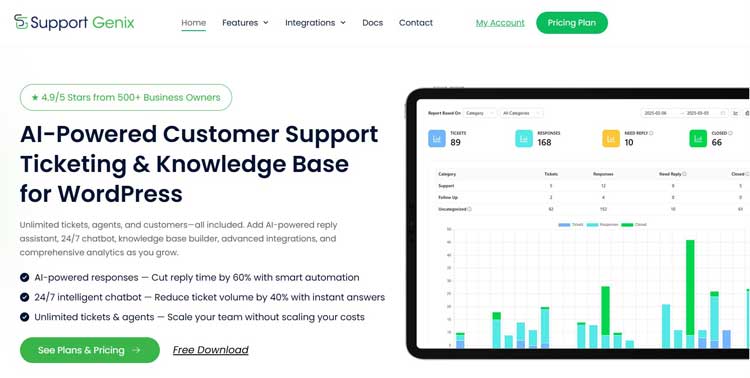
Support Genix is a WordPress helpdesk plugin built for this. It gives you a full ticketing system, AI chatbot, and knowledge base in one place, so your support team can resolve issues faster while your customer success layer focuses on proactive value delivery.
Other dedicated customer success platforms worth exploring are covered in the best customer success management tools roundup.
Support Genix
WordPress Support Ticket Plugin
Take Your Customer Support to The Next Level and Boost Customer Satisfaction Rates
Customer Success vs. Customer Experience: What Is the Difference?
These two terms often get used interchangeably, but they are not the same thing.
Customer experience (CX) covers every touchpoint a customer has with your brand, from the first ad they see to the invoice they receive. It is broad and cross-functional.
Customer success is narrower and outcome-focused, specifically about ensuring customers achieve their goals using your product or service.
CX shapes perception. Customer success drives retention and expansion. You need both, but they require different strategies, teams, and metrics.
Customer Success vs. Customer Experience: What Is the Difference?
These two terms often get used interchangeably, but they are not the same thing.
Customer experience (CX) covers every touchpoint a customer has with your brand, from the first ad they see to the invoice they receive. It is broad and cross-functional.
Customer success is narrower and outcome-focused, specifically about ensuring customers achieve their goals using your product or service.
CX shapes perception. Customer success drives retention and expansion. You need both, but they require different strategies, teams, and metrics.
Customer Success Examples (SaaS and WordPress)
Real-world customer success examples make the difference between theory and practice.
Example 1 – SaaS analytics platform
A SaaS analytics tool designs a customer success process where CSMs run onboarding calls, monitor usage, and trigger playbooks when adoption slows. By focusing on activation and expansion, the team lifts NRR above 115% and reduces churn.
Example 2 – WordPress membership site
A WordPress membership site uses a support ticket plugin and knowledge base to handle questions about billing, access, and content. Its customer success manager reviews ticket trends weekly, updates onboarding content, and checks in with high-value members before renewals.
Example 3 – Digital course business
A course creator maps a simple customer success lifecycle model: onboarding email sequence, mid-course check-ins, completion surveys, and upgrade offers. As a result, completion rates rise and more students buy advanced programs.
Each of these examples shows customer success management as a structured framework, not a loose collection of tasks.
Common Customer Success Mistakes to Avoid
Even well-intentioned CS programs fail when they make these mistakes.
- Waiting for customers to reach out: by the time they contact support, they may have already decided to churn.
- Treating all customers the same: high-value accounts need more attention than low-usage ones, so segment your outreach.
- Measuring support metrics only: resolution time and CSAT are important, but they do not capture long-term customer health.
- Skipping onboarding: rushing customers past setup without proper guidance is one of the fastest routes to early churn.
- Siloing CS from product and sales: customer success insights should flow into every part of your business.
Frequently Asked Questions
What is the main goal of customer success?
The main goal is to help customers achieve their desired outcomes using your product, so they stay longer, expand their usage, and become advocates for your brand.
Is customer success only for SaaS companies?
No. While customer success originated in SaaS, any subscription-based or relationship-driven business benefits from it, including e-commerce, professional services, and digital product companies.
What is the difference between a customer success manager and a customer support agent?
A support agent resolves issues when they arise. A customer success manager proactively manages the customer relationship over time, monitors account health, and drives renewals and expansion.
How do I measure if my customer success efforts are working?
Track churn rate, NRR, NPS, and customer health scores over time. If churn is falling and NRR is rising, your CS function is working.
When should a small business start investing in customer success?
As soon as you have recurring customers. Even a basic onboarding email sequence and a 30-day check-in call can make a measurable difference in early retention
Final Thoughts
Conclusion
Customer success and customer support share the same ultimate goal: happy customers who stay and grow with your business. The difference is in timing and mindset.
Support answers questions after something goes wrong. Customer success designs journeys and processes so those problems are less likely to appear in the first place.
If you treat customer success as a core growth function, with clear metrics, a well-defined lifecycle, proactive outreach, and the right software, you turn every new customer into a long-term relationship instead of a one-time transaction.