Happy to Help Alternatives: 5 Professional Phrases (With Examples) for Customer Service

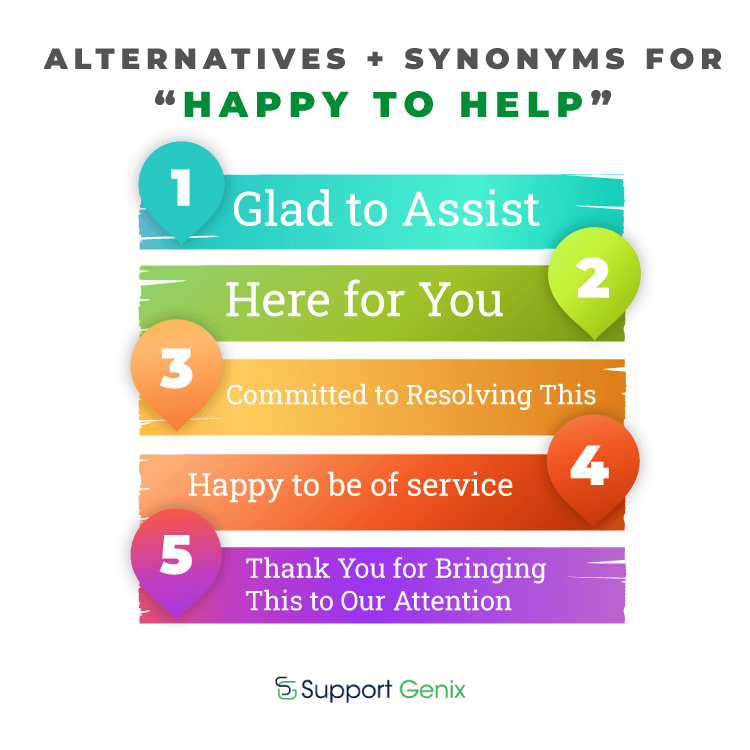
Quick Answer: “Happy to help” is polite but overused and can sound less genuine in customer service. Use professional alternatives like “Glad to assist,” “Here for you,” “Committed to resolving this,” “Happy to be of service,” or “Delighted to support” to show empathy, ownership, and ongoing support in email, chat, and phone conversations.
“Happy to help” is one of the most common customer service phrases—but when every agent uses it in every reply, it starts to feel scripted instead of sincere. Customers now expect human, empathetic language across email, chat, and phone support, not just copy‑and‑paste responses.
In this guide, we’ll explore the meaning of “happy to help,” why support teams should avoid overusing it, and 5 great alternatives and synonyms you can use instead. You’ll also find professional examples for email, chat, and phone support so you can quickly replace “happy to help” with more genuine, customer‑centric phrases.
Support Genix
WordPress Support Ticket Plugin
Take Your Customer Support to The Next Level and Boost Customer Satisfaction Rates
The meaning of “Happy to Help” and why we need Alternatives
“Happy to help” is a positive customer service phrase used to respond to thanks and show willingness to assist. It signals that you enjoyed supporting the customer and are open to helping again in the future.
However, because the phrase appears in so many scripts and canned replies, it can come across as generic or insincere—especially if it is the only line your team uses. Some customers may even feel they are talking to a template, not a real person.
That is why it helps to have several **happy to help alternatives** that sound more personal, specific, and situation‑aware. By varying your wording while keeping a friendly tone, you can show empathy and ownership in every interaction.
How to stop saying “happy to help”?
Breaking the habit of defaulting to “happy to help” takes a bit of practice but is very achievable with a few simple steps.
- Create a quick cheat sheet: Keep a short list of alternatives like “Glad to assist,” “Here for you,” “Happy to be of service,” and “Committed to resolving this” near your help desk tool or saved replies.
- Pause before sending: Before hitting send, ask yourself: “Does this phrase match the situation, or am I using it automatically?” If it feels automatic, swap in a more specific line.
- Use saved replies wisely: Configure your help desk or WordPress support ticket plugin (like Support Genix) with multiple saved replies that rotate different customer service phrases instead of just one “happy to help” template.
- Coach your team: Encourage agents to read the customer’s message, mirror their tone, and choose a phrase that fits the context, rather than pasting the same response every time.
Over time, your replies will sound more natural, and your customers will feel that every response is written for them—not just pulled from a script.
Recommended Blogs for You:
👉 Top Customer Support Tools Every Business Needs
👉 Tips to Improve Your SaaS Customer Support Strategy
👉 Dos and Don’ts of Effective Customer Support
👉 How to Hire a Customer Support Representative
👉 The Top Features to Look in WordPress Support Ticket Plugin
5 Alternatives for “Happy to Help” (With Example)
Below are five powerful alternatives and synonyms for “happy to help” you can start using right away. Each phrase includes when to use it and a simple example you can adapt
1. Glad to Assist
“Glad to assist” is a friendly, professional alternative that works well in most support situations. It keeps the positive tone of “happy to help” while sounding a bit more polished.
Use it when:
- You’ve just answered a question or solved a simple issue
- You want to sound warm but still professional in email or chat
- You’re responding to “thank you” or “that helps a lot”
Example responses
- “I’m glad to assist with this. If anything else comes up, just reply to this message.”
- “Glad to assist! Let me know if you’d like me to double‑check anything else.”
You can also use similar variants like “glad to help” or “I’m more than happy to assist” when you want a slightly more informal tone.
2. Here for You
“Here for you” underscores reliability and ongoing support rather than just closing a ticket. It works particularly well for long‑term customers, subscriptions, or SaaS products where relationships matter.
Use it when:
- You want to reassure a frustrated customer
- You’re handling a multi‑step or ongoing issue
- You want to emphasize customer satisfaction and loyalty
Example responses
- “Absolutely, we’re here for you whenever you need assistance—just open a ticket or reply here.”
- “We’re here for you if you have any other questions about your account or setup.”
Phrases like “we’re always here to help” or “we’re here for you and your team” are also strong choices for B2B and enterprise customers.
3. Committed to Resolving This
“Committed to resolving this” is a powerful phrase that shows ownership and determination to fix the problem. It’s especially useful when dealing with complaints, bugs, or escalated tickets.
Use it when:
- The customer has experienced an error, delay, or inconvenience
- You need to show you take the issue seriously
- You’re setting expectations about next steps or timelines
Example responses
- “Rest assured, we’re committed to resolving this issue as quickly as possible and will update you by tomorrow.”
- “I’m personally committed to resolving this for you and will follow up once we’ve confirmed the fix.”
This alternative makes your support feel proactive rather than reactive, which can reduce frustration and rebuild trust.
4. Happy to be of service
“Happy to be of service” is a slightly more formal synonym for “happy to help” that still sounds warm and appreciative. It works well in email, especially with business clients.
Use it when:
- You want a polite, professional closing line
- You’re responding after a successful resolution
- You want to show gratitude for the customer’s trust
Example responses
- “I’m happy to be of service. Please feel free to reach out if you need any further assistance.”
- “It was a pleasure assisting you today—we’re happy to be of service whenever you need us.”
You can also try phrases like “happy to be of assistance” or “it’s my pleasure to assist you” to keep your responses varied.
5. Thank You for Bringing This to Our Attention
“Thank you for bringing this to our attention” acknowledges the customer’s effort in reporting an issue and shows that feedback is valued. It’s particularly effective when customers highlight bugs, billing problems, or confusing experiences.
Use it when:
- A customer reports a bug, error, or broken link
- Someone points out a confusing process or missing information
- You want to encourage feedback and show you listen
Example responses
- “Thank you for bringing this to our attention—we’ve identified the cause and are working on a fix.”
- “We really appreciate you flagging this. Thank you for bringing it to our attention and helping us improve.”
This phrase pairs well with a clear explanation of what you’re doing next and when the customer can expect an update.
Professional Ways to Say “Happy to Help” in Email (With Examples)
When you’re writing customer service email templates, the way you sign off matters. Here are some professional alternatives to “happy to help” you can plug directly into your emails and support ticket replies:
- “I’m glad to assist with this request. If you need anything else, just reply to this email.”
- “We’re always happy to assist you and appreciate your patience while we fixed this.”
- “I’m committed to resolving this for you and will update you as soon as it’s done.”
- “I’m happy to be of service—please let us know if there’s anything more we can do.”
- “Thank you for bringing this to our attention. We’ve reviewed the issue and here’s what we’ve done so far.”
These examples naturally include high‑intent search phrases like “professional way to say happy to help,” “happy to help email response,” “we are happy to assist you,” and “happy to be of assistance,” which people often search for when writing support messages.
Choosing the Right Response for Every Scenario
Choosing the right response for every scenario in customer service is crucial for ensuring customer satisfaction and resolving issues effectively. It involves understanding the customer’s needs, emotions, and the context of their inquiry or concern.
Keep these principles in mind:
- Listen actively: Take time to fully understand the customer’s issue or question before replying. Active listening helps you pick the most appropriate phrase and solution.
- Show empathy: Acknowledge the customer’s feelings and situation with phrases like “I understand how frustrating this must be” before you offer a solution.
- Tailor your response: Customize your language to the customer and their context—formal for business emails, more conversational for chat, and supportive for sensitive issues.
- Be clear and concise: Avoid jargon and long paragraphs. Explain what you’ve done, what happens next, and how they can contact you if they still need help.
- Offer options when possible: Giving customers choices (like different time slots, channels, or solutions) helps them feel more in control and satisfied.
When you combine these practices with better phrases than “happy to help,” your communication becomes more effective and trustworthy.
What is the Power of Positive words in Customer Service?
Positive words play a huge role in shaping the overall customer experience and brand perception. They help customer service representatives create a friendly and supportive environment, which builds trust and encourages loyalty.
Using positive customer service phrases:
- Conveys empathy and understanding (“I completely understand how that feels”)
- Reduces frustration by focusing on solutions instead of problems (“Let’s get this fixed for you”)
- Encourages constructive interactions even in difficult situations (“Thank you for your patience while we sort this out”)
When you replace generic lines like “happy to help” with more specific, positive language, you create more meaningful connections with customers and stand out from competitors who rely on scripts.
How the Right Words and Phrases Enhance Customer Satisfaction and Loyalty
The right words and phrases are powerful tools for enhancing customer satisfaction and building long‑term loyalty. In many cases, customers remember how you spoke to them more than the exact steps you took.
Effective happy to help alternatives help you:
- Personalize communication
Tailoring your language to what the customer needs (reassurance, clarity, speed) shows attentiveness and care. - Create positive interactions
Friendly, encouraging language leads to better experiences and more positive word‑of‑mouth. - Show ownership and reliability
Phrases like “I’m committed to resolving this” and “We’re here for you” prove you stand behind your product and support.
Over time, this kind of communication increases repeat purchases, reduces churn, and strengthens your brand reputation.
5 Common Customer Service Phrases to Avoid
While positive phrases are important, some common expressions can unintentionally damage the customer experience. Here are five to avoid—and what to say instead:
- “I don’t know.”
Instead: “That’s a great question. Let me find out for you and get back to you shortly.” - “That’s our policy.”
Instead: “Here’s why we have this policy, and here’s what I can do for you within these guidelines.” - “You’re wrong.”
Instead: “I see how you got that impression—let’s walk through what happened together.” - “Calm down.”
Instead: “I’m sorry this has been frustrating. Let’s see how we can fix this for you.” - “It’s not my fault.”
Instead: “I understand this is inconvenient. I’ll take ownership of this and work on a solution.”
Avoiding these phrases and using better alternatives alongside your new happy to help synonyms will help you create more respectful, productive conversations.
Support Genix
WordPress Support Ticket Plugin
Take Your Customer Support to The Next Level and Boost Customer Satisfaction Rates
Frequently Asked Questions
Q. What is a professional way to say “happy to help”?
A: You can say “I’m glad to assist,” “I’m happy to be of service,” “I’m delighted to support you with this,” or “We’re always happy to assist you” as professional alternatives to “happy to help” in customer service.
Q: Is it OK to say “always happy to help” to customers?
A: Yes, “always happy to help” is acceptable in friendly customer service contexts, but using it in every reply can sound scripted. Mix it with phrases like “I’m committed to resolving this” or “Your satisfaction is important to us” to keep your messages fresh and genuine.
Q: What can I say instead of “happy to help” in live chat?
A: In live chat, short phrases like “Absolutely, I can help with that,” “No problem—let me check this for you,” or “I’m here for you, give me a moment to look into it” feel natural and conversational while still sounding professional.
Q: How do I reply to “thank you” without sounding repetitive?
A: Rotate phrases such as “You’re very welcome,” “I’m glad we could get this sorted out,” “Your satisfaction means a lot to us,” and “It’s my pleasure—reach out anytime you need support” instead of relying only on “happy to help.”
Conclusion
Choosing the right words matters just as much as solving the problem in customer service. By replacing an overused phrase like “happy to help” with thoughtful alternatives such as “glad to assist,” “here for you,” or “committed to resolving this,” you show real empathy, ownership, and respect for your customers’ time.
Start testing these happy to help alternatives in your support emails, live chats, and Support Genix ticket replies to build stronger relationships, boost satisfaction, and keep your brand voice friendly yet professional.