Customer Support for Startups: Why Customer Support Should Be a Priority for Startups

As a startup, every customer interaction has the power to accelerate or slow down your growth. Strong customer support for Startup ensures that early users feel heard, helped, and confident using your product.
Instead of treating support as a side task, startups should design a clear process for handling questions, bugs, and feature requests. This early investment in customer support for Startup creates a smoother experience, reduces churn, and gives your team valuable insight into what customers actually need.
When customers see fast, thoughtful responses, they are more likely to recommend your startup to others. Over time, this combination of reliable support and word‑of‑mouth becomes a key engine of sustainable growth.
Quick Answer:
Customer support for startups is the system, people, and tools you use to help customers quickly when they have questions or problems. When you prioritize support from day one, you increase retention, reduce acquisition costs, and build a brand people trust and recommend.
Customer Support for Startups: Overview
Customer support is the process of helping customers use your product, solve issues, and get value from what they’ve already bought. For startups, this support often happens across email, live chat, ticketing systems, and self‑service knowledge bases.
Because startups operate with limited time, budget, and people, every customer conversation is more valuable, not less. A small team that responds fast and solves problems properly often beats a bigger competitor with slow, impersonal support.

Startup customer support also relies on modern tools and data. You combine ticketing, automation, and analytics so you can handle more requests without burning out your team.
Why Customer Support Matters for Startup Success
Support, Satisfaction, and Loyalty
Good customer support directly improves satisfaction and loyalty. Customers who feel heard and helped are far more likely to stay, upgrade, and recommend your product to others.
Multiple industry studies show that acquiring a new customer is dramatically more expensive than keeping an existing one. Invesp, for example, reports that acquisition can cost 5–25 times more than retention:
Retained customers also tend to spend more over time. This makes customer support one of the highest‑ROI investments a startup can make.
Retention vs Acquisition for Startups
Early‑stage teams often focus heavily on acquisition—ads, campaigns, and launches. But without retention, that spend leaks away quickly. When you improve support, you reduce churn and increase lifetime value. That gives you more runway from the same budget and stabilizes your revenue as you grow.
Brand Reputation and Word of Mouth
Support is often the only human touchpoint customers have with your brand. A helpful, empathetic interaction builds trust faster than any marketing campaign.
Poor support, on the other hand, leads to complaints, bad reviews, and lost revenue. Startups don’t have the brand history to absorb many mistakes, so a reliable support experience is critical.
What “Customer Support for Startups” Really Means
Startup customer support is more than answering emails.
It is a structured system for handling questions, problems, and feedback at scale.
Key elements include:
- Clear channels for contact (email, chat, ticketing, self‑service).
- Documented workflows for triage and resolution.
- Ownership and accountability for each request.
- Measurement of response time, resolution rate, and satisfaction.
This system lets you respond fast, learn from patterns, and improve your product. At the same time, it keeps customers confident that someone is paying attention when they reach out.
Core Strategies for Prioritizing Customer Support
1. Hire the Right People for Support Roles
Support roles are not “nice‑to‑have” in a startup. The people in these seats shape customer perception every day.
Look for agents who are empathetic, patient, and strong communicators. They should be comfortable with technical troubleshooting and able to explain solutions in simple language.
A good support team can handle billing issues, bug reports, and feature requests without making customers feel blamed or ignored. You can deepen their skills with internal resources like your ticket history and guides such as:
2. Build a Customer‑Centric Culture
Customer support works best when it is part of your culture, not just a department. Founders, product teams, and marketers should all spend time reading tickets and talking to customers.
Put customer satisfaction on the same level as new feature releases. Make it clear inside the company that fast, high‑quality support is part of what makes your product “good”.
Practical ways to build this culture include sharing weekly support highlights with the whole team. You can also use customer stories and complaints directly in product planning meetings.
For deeper alignment, you can link and refer to:
3. Use the Right Tools and Technologies
Manual inboxes don’t scale for startups. You need tools that help you respond faster, track history, and automate routine work.
Common tools include:
- Support ticketing systems to centralize all requests.
- Live chat and messaging for real‑time help.
- Knowledge bases for self‑service answers.
- CRM and analytics to connect support data with product and revenue.
Well‑implemented ticketing systems significantly improve satisfaction by making every ticket traceable and easier to manage. They also give you reporting, so you see where customers struggle and can fix root causes.
Useful related resources on your site include:
4. Design Support for Startup Growth
Your support process should work when you have 50 customers and when you have 5,000. That means planning for growth early.
Focus on clear roles so each type of issue has an owner. Set up simple rules to route tickets, and add light automation to handle repetitive tasks.
As you scale, make sure response times stay reasonable and quality stays high. You can use guides like How to scale customer support when you begin building multi‑agent workflows and reporting dashboards.
Support Genix
WordPress Support Ticket Plugin
Take Your Customer Support to The Next Level and Boost Customer Satisfaction Rates
6 Best Customer Service Support Tools for Startups
Below are six popular tools that startups use to manage customer support. Each has strengths that suit different team sizes and budgets.
Support Genix
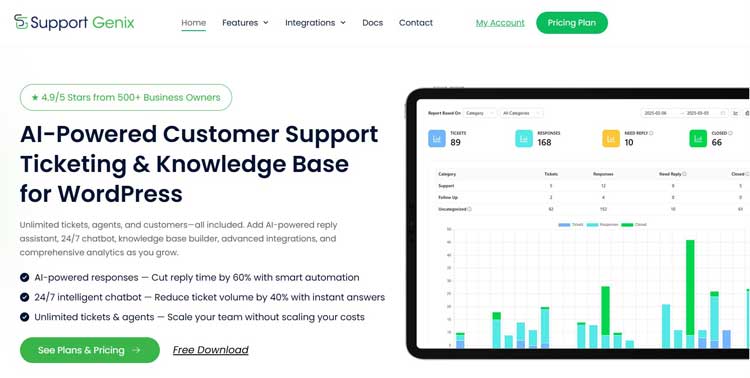
Support Genix is a WordPress support ticket plugin built for startups and small teams that run their websites on WordPress. It lets customers submit tickets directly from your site and helps agents manage those tickets in a structured workspace.
Key benefits for startups:
- Unlimited tickets, users, and agents, so you don’t hit caps as you grow.
- Centralized ticket management instead of messy email threads.
- Integration with AI‑powered reply assistants, knowledge base, and chatbot features in the Support Genix ecosystem.
Highlighted features:
- Agent roles for clear responsibilities.
- Filters and sorting to find tickets quickly.
- Custom ticket status workflows from new to closed.
- Unlimited tickets with no per‑ticket fees.
Pricing: There are 2 different pricing for Support Genix:
Yearly
- Personal Plan: $59/year
- Developer Growth Plan: $99/year
- Agency Plan: $149/year
Lifetime
- Personal Plan: $199/Lifetime
- Developer Growth Plan: $399/Lifetime
- Agency Plan: $699/Lifetime
If your startup already uses WordPress, Support Genix offers a simple way to add professional support without building a custom system from scratch.

Zendesk
Zendesk is a widely used cloud support platform with a ticketing system, help center, and automation tools. Startups often choose it when they need enterprise‑grade capabilities from the beginning.
Key capabilities:
- Messaging and live chat across web and mobile.
- AI and automation to handle routine tasks and triage tickets.
- Help center for self‑service articles.
- Unified agent workspace for all channels.
Zendesk’s suite plans are priced per agent per month. This makes it suitable for growing teams that can invest in a robust, multi‑channel support stack.
Pricing: There are 4 different pricing for Zendesk:
- Suite Team Plan: $59/monthly & $55/yearly
- Suite Growth Plan: $115/monthly & $99/yearly
- Suite Professional Plan: $149/monthly & $115/yearly
- Suite Enterprise Plan: Talk to sales
HappyFox
HappyFox is a help desk and customer support platform designed to bring order to high volumes of inquiries. It focuses on organizing tickets and allowing teams to create self‑service knowledge bases.
Key strengths:
- Ticketing system that centralizes email, chat, and web requests.
- Knowledge base for FAQs and how‑to guides.
- Automation rules that reduce repetitive manual work.
- Task management for internal follow‑ups.
HappyFox offers both agent‑based and unlimited‑agent pricing tiers. This makes it flexible for startups that might expand or work with external support partners.
Pricing: There are different pricing for HappyFox:
Agent based:
- Help Desk: starting at $24 per agent/month
- Contact Center Suite: starting at $99 per agent/month
- Service Desk: starting at $49 per agent/month
Unlimited agents:
- Help Desk is also available with unlimited agent pricing, offered as custom volume‑based annual plans.
Zoho Desk
Zoho Desk can elevate your customer service efforts to new heights. From omnichannel support to integration with popular instant messaging platforms, it empowers you to provide seamless and efficient support experiences.
This help desk software offers a multi-brand help center, allowing you to create separate self-service portals for each brand’s customers. Additionally, it provides multi-departmental support, organizing your help desk to align with your company’s unique structure.
Zoho Desk simplifies email communication, providing context-driven interactions that streamline communication and enhance customer satisfaction. Ultimately, leveraging customer service interaction allows you to make informed decisions that enhance the overall customer experience and drive business growth.
Pricing: There are 2 different pricing for Zoho Desk:
Monthly
- Standard Plan: $14/month
- Professional Plan: $23/month
- Enterprise Plan: $36/month
Yearly
- Standard Plan: $9/year
- Professional Plan: $16/year
- Enterprise Plan: $27/year
Freshdesk
Freshdesk customer service software empowers support teams to provide timely and consistent assistance at any scale. Customers can find answers faster with automated self-service options, including a scalable knowledge base and custom widgets. Integration with custom apps tailors the self-service experience to meet specific business needs.
AI-powered automation eliminates redundancy, allowing customer service teams to operate efficiently. Generative AI assists agents in delivering accurate resolutions, enhancing productivity. The team inbox enables tracking and managing incoming support tickets from multiple channels in one convenient location.
Highlighted Features:
- SLA management
- Linked tickets
- Custom ticket status
- Automatic email notification
- Agent collision detection
Pricing: There are 4 different pricing for Freshdesk:
- Free
- Growth Plan: $18/monthly & $29/yearly
- Pro Plan: $59/monthly & $49/yearly
- Enterprise Plan: $95/monthly & $79/yearly
Help Scout
Help Scout deliver excellent support effortlessly. Designed for customer-loving teams like yours, it offers AI features that knock out first drafts, summarize threads, and enhance responses, which makes support interactions smoother and more efficient.
With workflows that seamlessly flow, automation simplifies tasks from the simple to the complex, ensuring nothing falls through the cracks. Whether your team is small and scrappy or big and bustling, Help Scout provides tools to keep everyone on track and deliver exceptional service.
Highlighted Features:
- Shared Inbox
- Self-service
- Knowledge Base
- Live Chat
Pricing: There are 2 different pricing for Help Scout:
Monthly
- Standard Plan: $30/month
- Plus Plan: $54/month
- Pro Plan: 90/month
Yearly
- Standard Plan: $25/month
- Plus Plan: $45/month
- Pro Plan: $75/month
Frequently Asked Questions
Why is customer support essential for startups?
Customer support builds trust, enhances satisfaction, and fosters customer loyalty. It provides valuable feedback, reduces churn, and boosts growth.
Can outsourcing customer support be a good option for startups?
Outsourcing can work when you don’t have the budget or time to hire and train an in‑house team.It is especially helpful for coverage outside normal hours or in multiple languages. However, you should choose partners that match your brand voice and quality standards. Clear processes, playbooks, and shared tools are essential to keep the customer experience consistent.
What role does customer feedback play in improving support services?
Customer feedback identifies pain points, informs product improvements, and enhances service quality. It drives continuous improvement and customer satisfaction.
How can startups measure the effectiveness of their customer support efforts?
Track a small set of practical metrics:
1. Customer satisfaction (CSAT).
2. Net Promoter Score (NPS).
3. First contact resolution (FCR).
4. Average response and resolution times.
You can also monitor churn rates and repeat purchase behaviour. This shows how support influences real revenue and retention, not just ticket volume.
What are some common mistakes startups make with customer support?
Common mistakes startups make with customer support include neglecting to prioritize it, failing to respond in a timely manner, using impersonal or automated responses, and not properly training support staff.
Support Genix
WordPress Support Ticket Plugin
Take Your Customer Support to The Next Level and Boost Customer Satisfaction Rates
Final Thoughts on Customer Support for Startups
Customer support is not an optional add‑on for startups—it is a core part of your product experience. Good support makes customers feel confident choosing a young brand over a big incumbent.
When you invest in empathetic people, customer‑centric culture, and the right tools, you turn every conversation into data, loyalty, and growth. In the long run, this combination of support and retention creates a more stable, profitable startup than acquisition‑only strategies ever will.
If your product runs on WordPress, using a ticketing solution like Support Genix gives you a clean, scalable foundation for all of this work from day one. It lets you handle customer requests professionally while keeping setup and management simple for a busy startup team.