How to Train Your Customer Support Team to Provide Exceptional Service

Quick Answer:
To train your customer support team effectively, follow these five steps: assess your team’s current skill gaps, define clear performance goals, run structured training using role-play and real ticket scenarios, equip the team with the right tools, and track results with measurable KPIs. Below is how to do each one.
Poor customer support training is not just a HR problem — it directly costs you revenue. Research from Salesforce shows that 94% of customers who report a positive support experience are likely to purchase again. The opposite is also true.
Most companies skip the structured part of training. They onboard agents fast, give them a product walkthrough, and push them into the queue. Months later they wonder why CSAT scores are flat and ticket resolution times keep climbing.
This guide walks you through a proven training process — the kind that actually changes how your team handles real customers, not just how they perform in onboarding quizzes.
Table of Contents
How to Train Your Customer Support Team: Step-by-Step

Step 1: Assess Your Team Before You Train Them
Training without a baseline is guesswork. Before you plan a single session, you need to know where your team actually struggles.
Run a Skills Gap Assessment
Review the last 30 to 60 days of your support tickets. Look for patterns in:
- Tickets that were escalated unnecessarily
- Responses that missed the customer’s actual question
- Repeated mistakes across multiple agents
- High reopen rates on closed tickets
If you use a support ticketing plugin like Support Genix, you can filter tickets by agent and tag — this makes it much faster to spot individual-level gaps rather than just team-wide trends.
Conduct Agent-Level Performance Reviews
Measure each agent against three core dimensions:
- Response quality: Are answers clear, complete, and accurate?
- Speed: Are they hitting your target first-response time?
- Resolution rate: How often do they solve the problem in one ticket?
For a full breakdown of which metrics to track and how to calculate them, see our guide on how to measure customer service performance.
Set Specific Training Goals Before You Start
Once you have the data, define what success looks like. Use numbers, not adjectives. ‘Improve communication’ is not a goal. ‘Reduce escalation rate by 20% in 60 days’ is.
Step 2: Cover the Right Training Topics
Most support training programs cover too much theory and not enough practice. Here are the topics that actually move the needle:
Product Knowledge — The Non-Negotiable Foundation
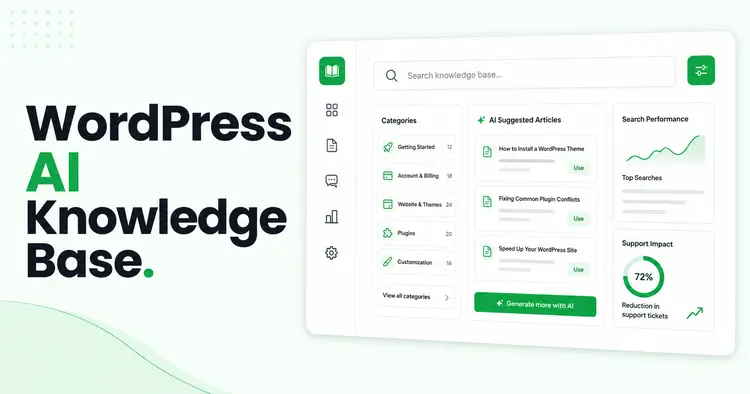
Your agents cannot help customers with a product they don’t understand themselves. Build a structured product knowledge base that agents can access during live tickets. If your team handles WordPress-based products, a well-structured WordPress knowledge base cuts resolution time significantly.
Communication Skills — How to Actually Write to Customers
The biggest training gap in most support teams is not product knowledge — it’s how agents phrase their responses. Train for:
- Writing short, clear sentences that match your customer’s reading level
- Leading with the solution, not with an apology or preamble
- Using the customer’s own words to show you understood their problem
- Avoiding passive voice and corporate-sounding language
Use your AI prompt templates to give agents a consistent starting point. Our post on AI prompt templates for customer service covers 10 copy-paste templates your team can adapt right away.
Conflict and Escalation Handling
Train agents to recognize when a ticket needs to be escalated — and when it doesn’t. Over-escalation burns your senior team’s time. Under-escalation creates angry customers. Role-play both scenarios in training so agents make better live judgments.
Empathy — Not a Soft Skill, a Conversion Driver
A customer who feels heard is far more likely to stay, even after a bad experience. Train agents to acknowledge the customer’s frustration before jumping to solutions. This is not about being nice — it’s about reducing reopen rates and negative reviews.
Step 3: Use Training Methods That Actually Work
Reading a manual is not training. Real learning happens through repetition and feedback. Here are the methods that produce measurable improvement:
Role-Play With Real Ticket Scenarios
Pull actual difficult tickets from your history and use them as training material. Have agents practice responding to these scenarios in pairs — one plays the customer, one plays the agent. Rotate roles. Debrief on what worked and what missed.
The advantage of using real tickets: agents immediately recognize the situations. It’s not hypothetical. They’ve seen something like it before, and they know the stakes are real.
Shadow Sessions and Peer Review
New agents should spend at least their first week shadowing experienced agents before handling live tickets independently. After that, run regular peer review sessions where agents review each other’s recent tickets — anonymized if needed — and give constructive feedback.
Micro-Training Over Marathon Sessions
A four-hour training day once a quarter is far less effective than 15-minute focused sessions weekly. Break your training content into short, repeatable modules. One topic per session. One skill at a time.
Simulate High-Volume Situations
If your team handles seasonal ticket spikes — Black Friday, product launches, outages — train for those conditions specifically. Simulate a high-volume scenario in a controlled environment. Agents who have practiced under pressure perform better when the real pressure hits.
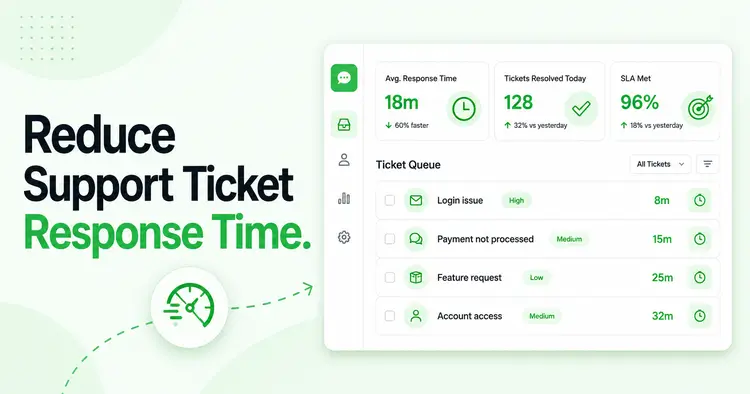
For teams struggling with response time during high-volume periods, see our guide on how to reduce support ticket response time.
Support Genix
WordPress Support Ticket Plugin
Take Your Customer Support to The Next Level and Boost Customer Satisfaction Rates
Step 4: Give Your Team the Right Tools
Training is only half the equation. If your team has the right training but the wrong tools, they will still be slow and inconsistent.
A Centralized Ticketing System
Handling customer requests over email is one of the most common mistakes growing support teams make. Email creates invisible queues, missed follow-ups, and no performance data. A proper ticketing system fixes all three.
Support Genix is built specifically for WordPress — it handles ticket assignment, agent-level tracking, WooCommerce integration, and email piping in one place. If your business runs on WordPress, it removes the need to bolt together multiple tools.
Get started: Download Support Genix free
A Searchable Knowledge Base
Agents should never have to remember product details from memory. Build a knowledge base they can search during live tickets. The faster an agent can find the right answer, the shorter your resolution time.
Workflow Automation for Repetitive Tasks
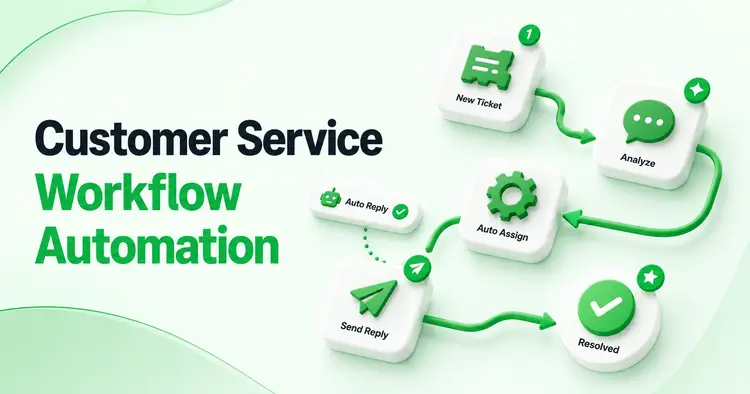
If your agents are manually routing tickets, sending the same acknowledgment emails, and following up on every single open ticket — they are wasting time that should go into complex problem-solving. Automate the predictable parts. Customer service workflow automation is now accessible even for small teams without engineering resources.
Step 5: Track Performance and Keep Improving
Training without measurement is a one-time event. Build a system where training is continuous and tied to real performance data.
Track These KPIs After Training
- First Response Time (FRT) — How quickly does an agent acknowledge a new ticket?
- First Contact Resolution (FCR) — What percentage of tickets are resolved without reopening?
- Customer Satisfaction Score (CSAT) — Are customers rating their support interactions positively?
- Escalation Rate — How often are tickets escalated to senior agents?
- Ticket Reopen Rate — How often does the customer come back with the same problem?
Review these numbers monthly — not quarterly. Monthly reviews catch skill regression before it becomes a customer-facing problem. Use the data to decide which training modules to repeat and which agents need targeted coaching.
Use Customer Feedback as Training Material
After every resolved ticket, send a short CSAT survey. When a customer rates their experience poorly, that ticket becomes a training case study. Bring it to your next team session and work through what should have happened differently.
For teams tracking multiple support metrics simultaneously, see our full guide on how to measure customer service performance — including calculation formulas for each KPI.
Support Genix
WordPress Support Ticket Plugin
Take Your Customer Support to The Next Level and Boost Customer Satisfaction Rates
Frequently Asked Questions
How long should customer support training take?
Initial onboarding training typically runs one to two weeks for basic proficiency. Full confidence with complex tickets usually takes 60 to 90 days of supervised work. Ongoing training — short sessions covering new products, edge cases, and skill refreshers — should happen every two to four weeks permanently.
What topics should customer service training cover?
The core topics are: product knowledge, clear written communication, empathy and tone, escalation judgment, conflict resolution, and tool proficiency. For support teams handling WordPress-based products, add training on your specific integrations and common technical issues customers raise.
How do you measure if customer service training is working?
Compare your key metrics before and after training: First Contact Resolution rate, Customer Satisfaction Score, average response time, and ticket reopen rate. If training is working, FCR goes up and reopen rates go down. A flat or declining CSAT score after training usually means the wrong topics were covered.
How do you handle an agent who isn’t improving despite training?
Start with a direct one-on-one review using specific ticket examples — not general feedback. Identify whether the problem is skill (they don’t know how) or will (they know but don’t apply it). Skill problems respond to more targeted training. Will problems require a different management conversation. If performance does not improve after structured support, that is an HR decision, not a training one.
What is the best way to train remote customer support agents?
Remote training works best with short video walkthroughs for product knowledge, async ticket review via comments in your ticketing system, weekly live role-play sessions over video call, and a shared knowledge base agents can access during live tickets. The biggest mistake with remote training is relying entirely on written documentation — remote agents need live practice just as much as in-office agents.
Final Thoughts
A well-trained support team is not built in a two-day onboarding. It’s built through consistent short training sessions, real ticket data, honest feedback, and the right tools to back everything up.
The teams that improve the fastest share one habit: they treat every resolved ticket as data. They look at what went well, what didn’t, and they adjust. That feedback loop — between real customer interactions and training content — is what separates a support team that slowly improves from one that stays stuck.
If you’re building or rebuilding a support operation on WordPress, Support Genix gives you the ticket management infrastructure to make that feedback loop practical — without stitching together five different tools.
Download Support Genix for free and start building a team that closes tickets on the first try.